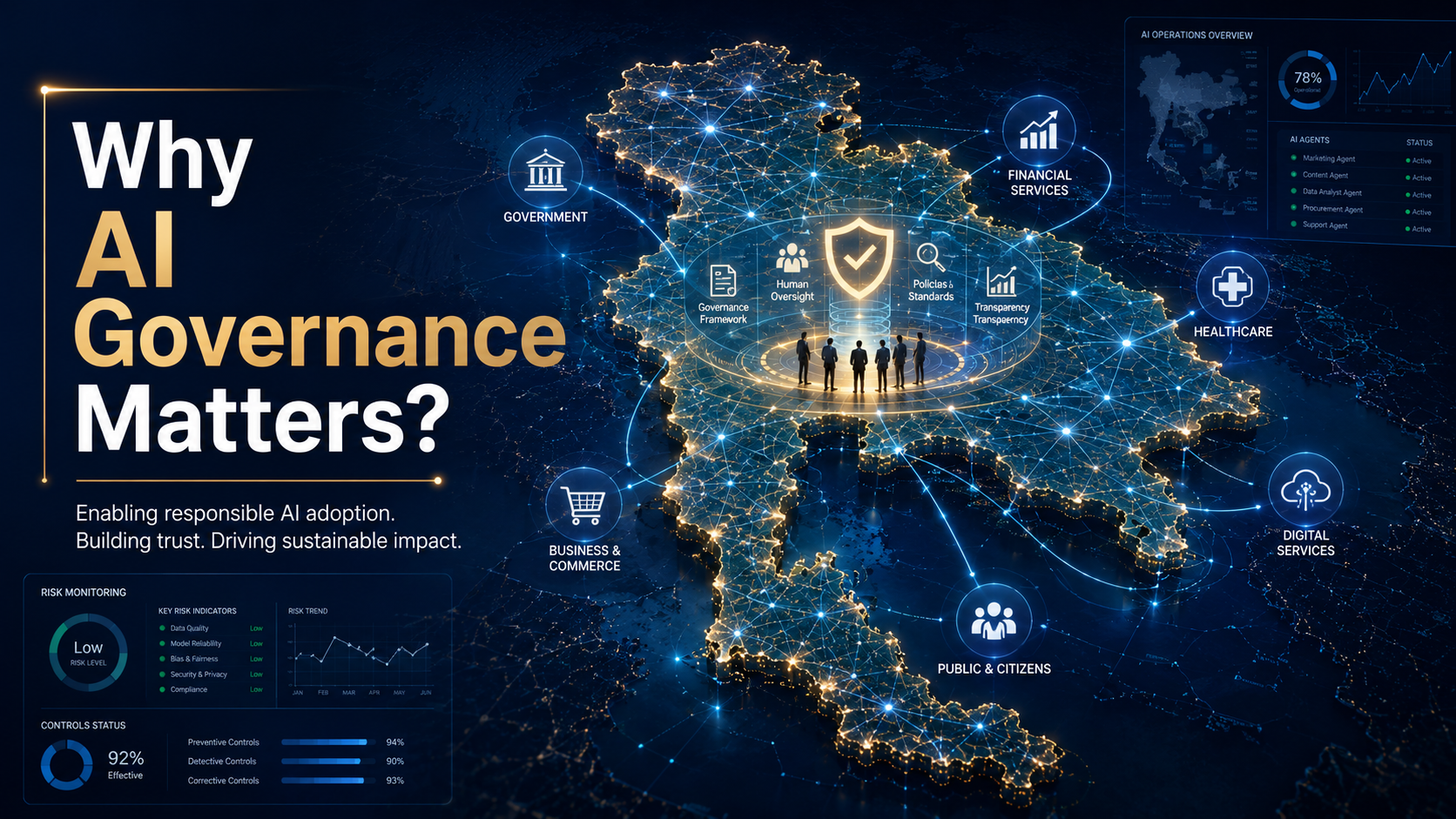
Why AI Governance Matters?
A mistake made by an employee may affect a few customers.
A mistake made by an AI system may affect hundreds or even thousands before it is detected.
As organizations increasingly adopt Agentic AI solutions, AI is evolving beyond a simple assistive tool into systems capable of making decisions and taking actions with increasing levels of autonomy.
This creates a new challenge, as AI-related risks can scale much faster than traditional risks.
A mistake made by a single employee may affect a handful of customers. However, a failure in an AI system can be replicated at scale, potentially affecting hundreds or thousands of customers before it is identified and corrected.
This is one of the key reasons why AI Governance matters.
In Thailand, I have recently observed a growing interest in Agentic AI and AI-driven automation. Training programs, workshops, and demonstrations increasingly showcase how AI can perform tasks that previously required significant human effort.
For example, AI can automatically collect information from the internet, summarize content, generate images, and publish posts across social media platforms with minimal human involvement.
The productivity benefits are clear.
Organizations can reduce repetitive work, accelerate content creation, and improve operational efficiency.
However, this is precisely where governance questions begin to emerge:
• How do we verify the accuracy of information collected by AI?
• How should organizations address potential copyright concerns?
• Who is accountable if incorrect or harmful content is published?
• What response process should be followed if harm occurs?
In my view, many organizations are currently focused on the efficiency gains and cost savings that AI can deliver. While these benefits are important, conversations about governance, accountability, and risk management often receive far less attention. As AI systems gain greater autonomy and scale, these questions become increasingly important.
AI Governance is no longer solely a technology issue. It is increasingly becoming a leadership and governance issue that requires attention from executives and boards.
The question is no longer whether organizations should adopt AI.
The question is whether they are prepared to govern it responsibly.