When Governance Stops Being a National Priority
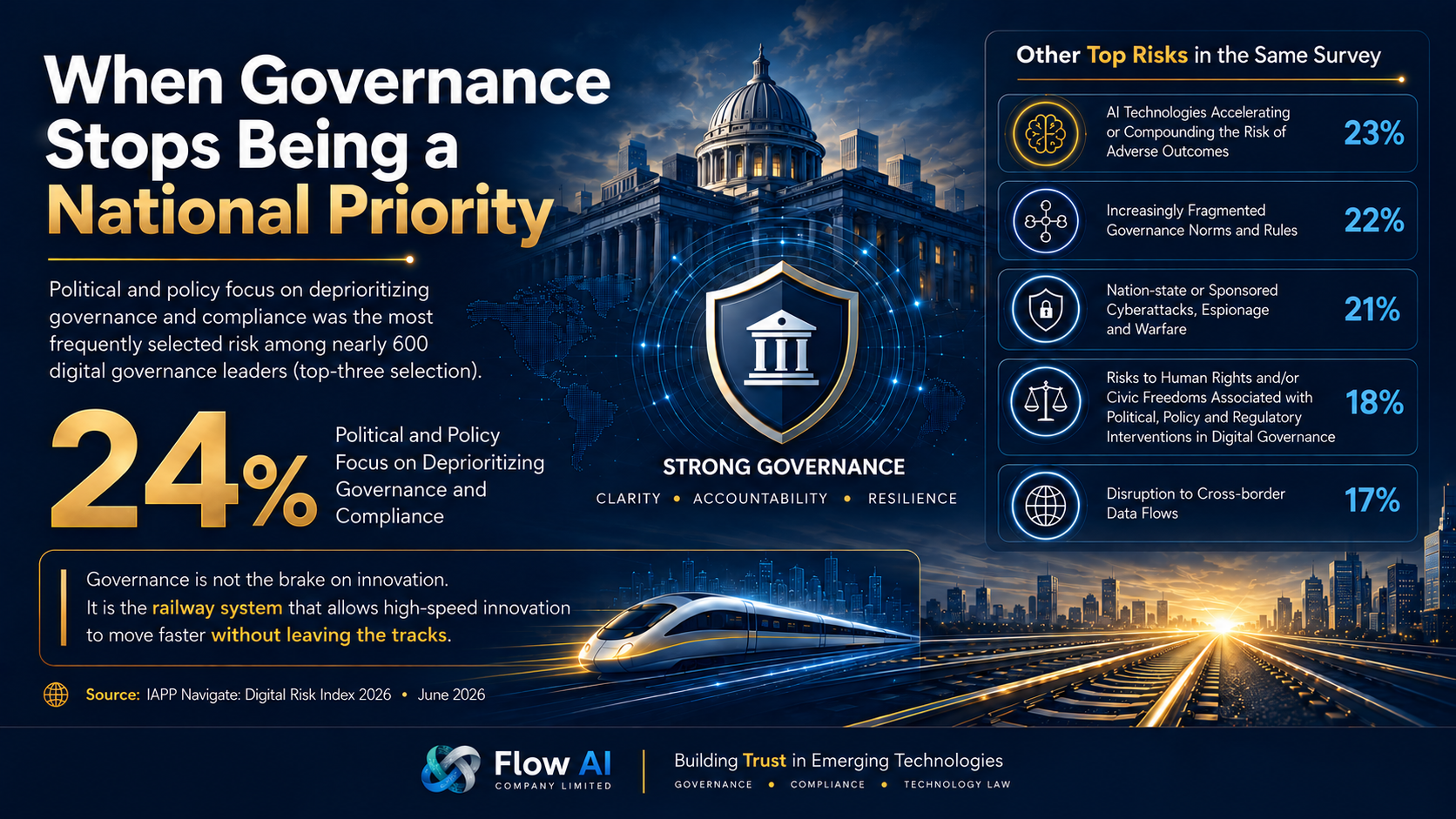
According to the newly released IAPP Navigate: Digital Risk Index 2026, nearly one in four digital governance leaders identified the deprioritization of governance and compliance at the policy level as one of the most significant digital risks facing society today.
That finding immediately stood out to me - not because it concerns regulation, but because it concerns the long-term resilience of entire digital ecosystems.
When governance is no longer treated as a national priority, regulations become less consistent, enforcement becomes less predictable, and institutional coordination gradually weakens.
Over time, digital trust begins to erode.
The survey reflects this broader concern.
As governance loses policy focus, experts also identified increasing risks of:
• Fragmented governance norms and regulatory approaches (22%)
• Nation-state cyberattacks, espionage, and cyber warfare (21%)
• Risks to human rights and civic freedoms arising from political and regulatory interventions (18%)
• Disruptions to cross-border data flows caused by legal, policy, vendor, or infrastructure constraints (17%)
These risks are interconnected.
Weak governance rarely creates only one problem. It often reduces the resilience of the entire digital ecosystem.
The challenge becomes even more significant when Artificial Intelligence enters the picture.
The same survey found that 23% of respondents identified AI technologies as accelerating or compounding the risk of adverse outcomes.
AI does not create every governance risk.
But without appropriate governance, it can significantly amplify existing governance failures.
Weak governance may lead to fragmented AI regulation, inconsistent oversight, reduced accountability, and declining public trust.
As AI capabilities continue to advance, governance becomes even more - not less important.
Drawing from my experience as a lawyer, an AI Governance Advisor, and a former operations executive, I do not see policy-level governance as an obstacle to innovation.
I see governance as part of the institutional infrastructure that allows innovation to scale responsibly.
Governments should not strengthen governance merely because digital risks are increasing.
They should strengthen it because governance is one of the foundations of national competitiveness, public trust, and long-term innovation.
Governance is not the brake on innovation.
It is the railway system that allows high-speed innovation to move faster without leaving the tracks.
Tomorrow, I will examine how this policy shift influences governance and compliance within organizations.
How is your country or industry responding to this changing policy landscape? I'd be interested to hear your perspective.
For a deeper discussion, please watch the full 14-minute episode on YouTube: https://youtu.be/72vpA6JfViA