When Businesses Deprioritize Governance, Risk Does Not Disappear
Yesterday, I discussed how the IAPP Navigate: Digital Risk Index 2026 identified the deprioritization of governance and compliance at the policy level as the most significant digital risk facing today's digital ecosystem.
The story, however, does not end there.
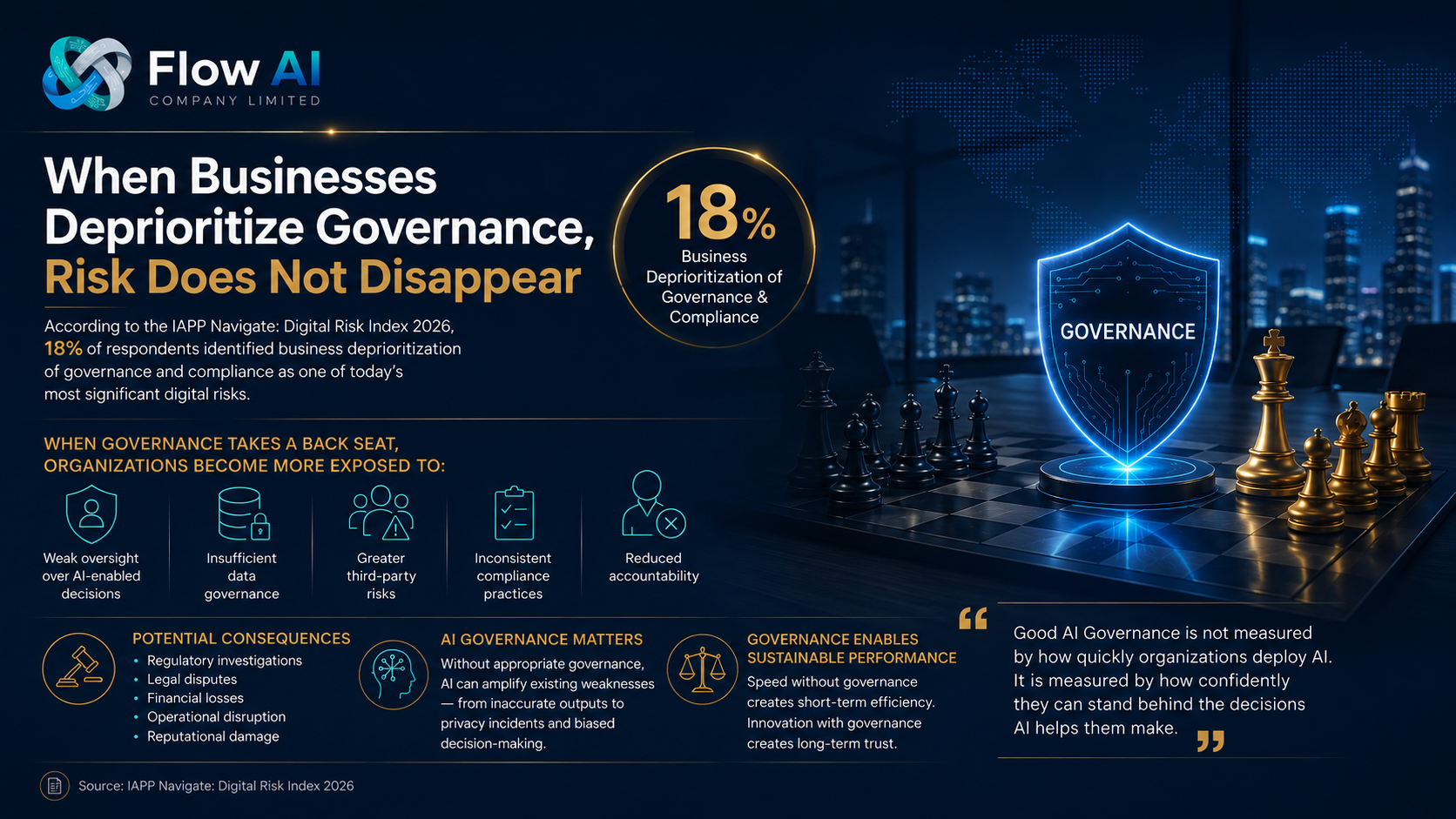
The same survey found that 18% of respondents identified business deprioritization of governance and compliance as one of today's most significant digital risks.
That finding deserves just as much attention.
Organizations rarely decide to ignore governance overnight.
Instead, it often begins with decisions that appear commercially reasonable.
"Let's launch first."
"We can strengthen governance later."
"We need to reduce compliance costs."
Individually, these decisions may seem manageable.
Collectively, they gradually weaken an organization's governance capability.
Over time, organizations become more exposed to:
• Weak oversight over AI-enabled decisions
• Insufficient data governance
• Greater third-party risks
• Reduced accountability
Eventually, these governance weaknesses may lead to regulatory investigations, legal disputes, financial losses, operational disruption, and reputational damage.
Artificial Intelligence makes this challenge even more significant.
AI itself is not the problem.
The governance surrounding AI determines whether organizations create sustainable value—or unintended risk.
Organizations deploying AI without appropriate governance may struggle to demonstrate due diligence, maintain effective human oversight, or respond confidently when incidents occur.
Increasingly, the question is no longer:
"Did the AI make a mistake?"
It is becoming:
"Can the organization demonstrate that it governed the AI appropriately?"
Drawing from my experience as a lawyer, an AI Governance Advisor, and a former operations executive, I do not believe governance competes with business performance.
I believe governance enables sustainable business performance.
Organizations that invest in governance early are often better positioned to innovate responsibly, demonstrate accountability, and maintain stakeholder trust over the long term.
Speed without governance may create short-term efficiency. But sustainable growth requires both innovation and accountability.
Good AI Governance is not measured by how quickly organizations deploy AI. It is measured by how confidently they can stand behind the decisions AI helps them make.
What governance decisions is your organization making today that will define its resilience tomorrow?
For a deeper discussion, please watch the full 11-minute episode on YouTube: https://youtu.be/VLyaKTfXpkI