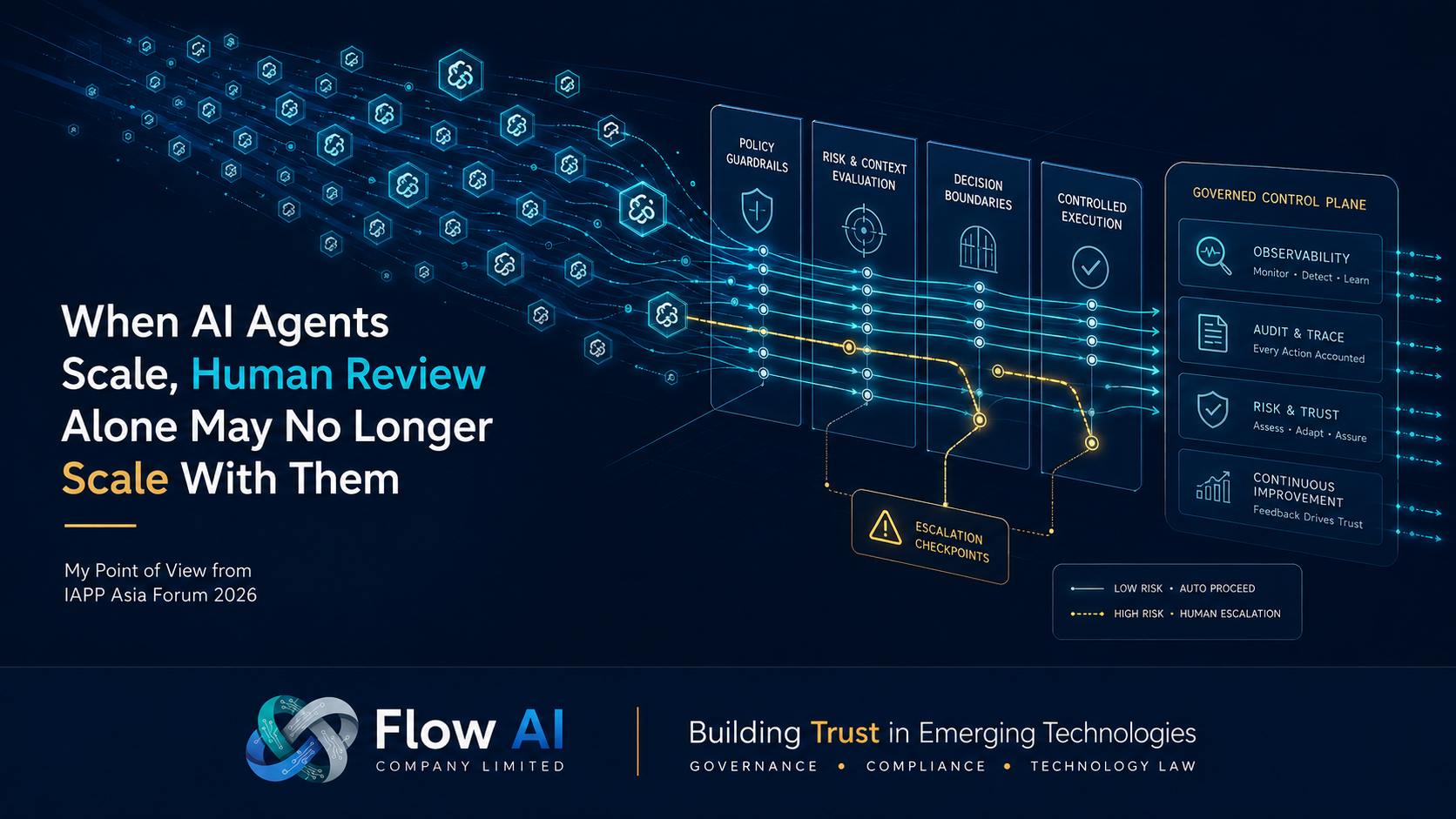
When AI Agents Scale, Human Review Alone May No Longer Scale With Them
Human oversight remains essential. But what happens when AI begins acting faster and at greater scale than humans can realistically review?
This was one of the questions that stayed with me after attending the “Agents Governing Agents” session at IAPP Asia Forum 2026 in Singapore.
The session contrasted the conditions where traditional human-in-the-loop governance works well — time, predictability, and manageable volume — with characteristics of agentic AI such as emergent behavior, non-determinism, and rapid scale.
IDC projects that more than one billion AI agents could be actively deployed worldwide by 2029. The exact trajectory remains uncertain, but the governance implication is already clear: manual review cannot remain the primary control for every autonomous action.
That does not mean removing humans from governance. It means changing where human judgment is applied.
Instead of asking people to approve every individual AI action, organizations need governance mechanisms that establish boundaries in advance, monitor behavior continuously, and escalate situations that genuinely require human judgment.
That can include automated guardrails, defined decision limits, observability, risk-based escalation, and clear intervention points. The session described this broader architecture through concepts such as always-on governance, containment, alignment, real-time risk review, and programmatic enforcement.
My takeaway: Governance must be capable of operating at the scale and speed of the systems it governs.
For boards, compliance, risk, legal, and technology teams, this changes the question.
The issue is no longer simply:
“Can a human review this AI decision?”
It is increasingly:
“Have we designed the system so that routine actions remain within governed boundaries — and the right issues reach the right humans at the right time?”
Human oversight still matters. But effective oversight at agentic scale cannot mean humans reviewing everything. It means designing governance so human judgment is used where it adds the most value.
Inspired by the “Agents Governing Agents” session at IAPP Asia Forum 2026. Views expressed are my own.