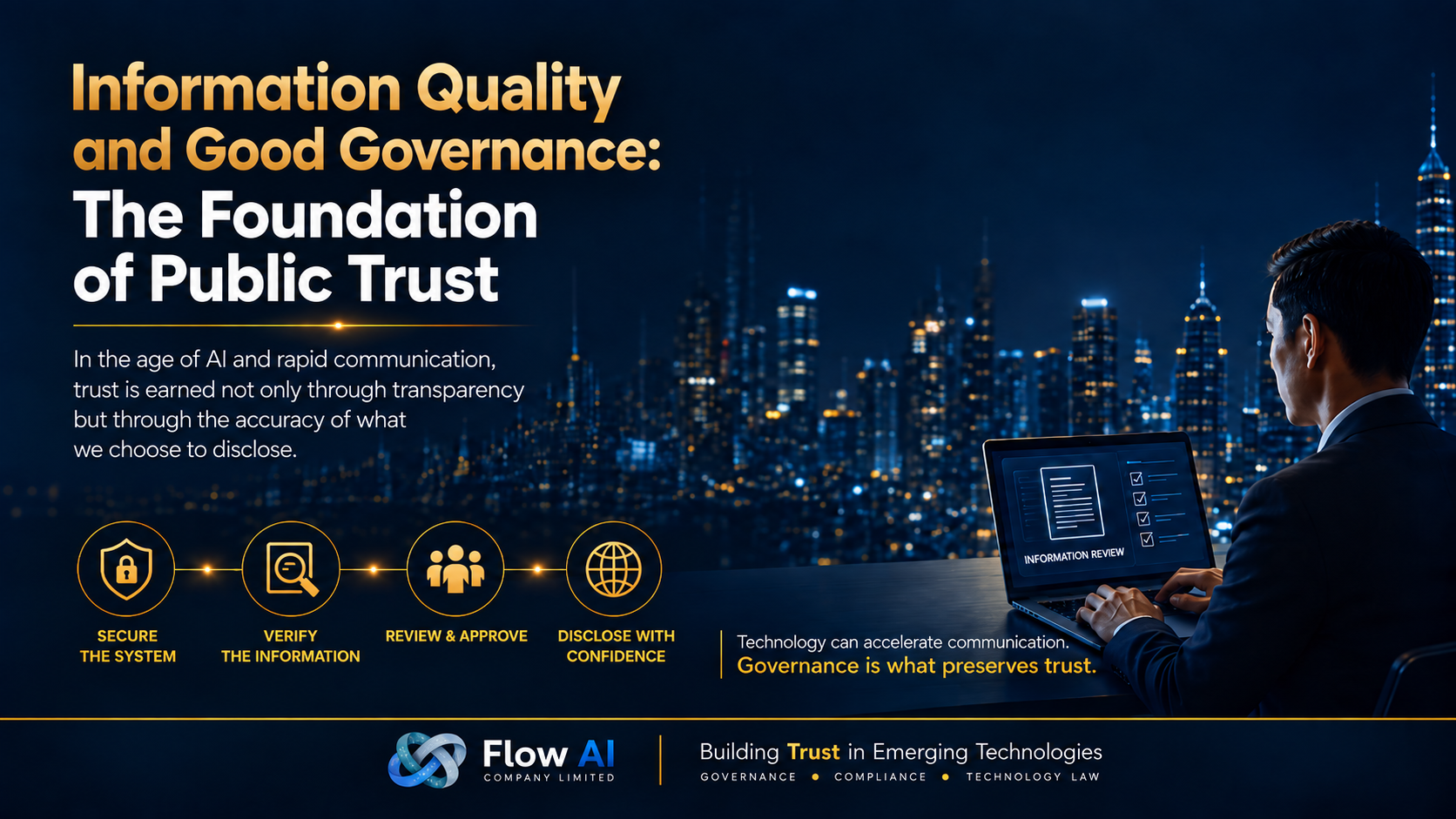
Information Quality and Good Governance: The Foundation of Public Trust
After following today's SEC clarification regarding the Form 246-2 filings, one lesson stood out to me.
Trust in capital markets—and in any information ecosystem—is built not only on transparency, but also on the accuracy of the information disclosed to the public.
According to today's SEC clarification, identity verification within the reporting system includes multiple security measures. However, the information that was submitted was later found to be inconsistent with factual records, prompting the SEC to flag the filings, verify them with the listed companies involved, and ultimately remove the incorrect information from public disclosure.
Rather than focusing on the specific case itself, I believe it offers an important governance lesson that extends well beyond the capital market.
Through both my work in AI Governance and my ongoing studies in Compliance & ESG at the Lawyers Council of Thailand, one principle has become increasingly clear to me: identity verification alone is not sufficient.
Organizations also need robust verification processes before information is released to the public.
Once information becomes publicly available, it can quickly influence decisions, shape perceptions, and spread across multiple channels. Even when incorrect information is corrected later, the confusion it creates may not disappear immediately.
This principle is becoming even more important as organizations increasingly use AI to support drafting reports, disclosures, presentations, and public communications.
AI can generate content within seconds.
It can produce professional-looking documents.
It can even sound highly convincing.
But none of these guarantees that the information is factually correct.
For that reason, AI Governance should not focus solely on controlling who can access AI systems or which models employees are permitted to use.
Equally important are the governance controls applied before AI-generated content is published.
These controls may include human review, factual verification, approval workflows, and clear accountability for the final disclosure.
Good governance is therefore not only about securing systems and controlling access.
It is also about ensuring that the information released from those systems is accurate, reliable, and appropriate for public reliance.
Whether the information comes from a regulatory filing, a corporate announcement, an ESG report, or AI-generated content, the same principle applies.
The cost of verifying information before publication is often far lower than the cost of correcting public misunderstanding afterwards.
As organizations continue adopting AI, this principle will become increasingly important.
Technology can accelerate communication.
Governance is what preserves trust.
For a deeper discussion, please watch the full 12-minute episode on YouTube: https://youtu.be/OhaUGV36Ehc