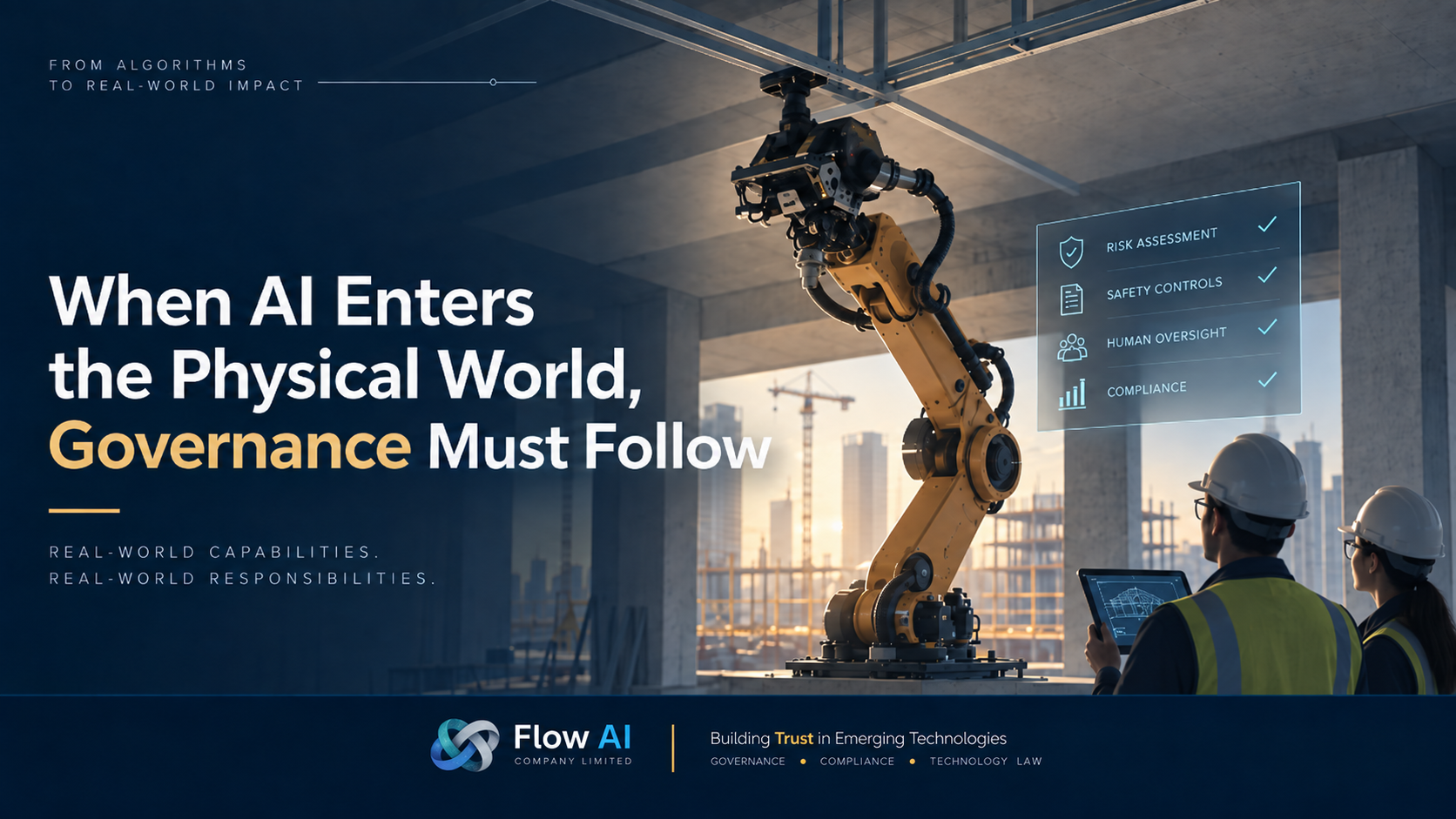
When AI Enters the Physical World, Governance Must Follow
Yesterday, I watched a demonstration of a robotic system performing construction-related tasks.
From the clip alone, I do not have enough information to determine how autonomous or “agentic” the system is.
But that was not what stayed with me.
What stayed with me was a different question:
Are our governance frameworks ready for the point when AI begins to act not only in digital environments, but in the physical world?
This raises two governance challenges.
The first is governing the transition itself.
As robotics becomes more capable, organizations will need to decide which tasks should be automated, which should remain human-led, and where human–robot collaboration makes more sense.
Those decisions affect more than productivity. They involve workforce redesign, reskilling, accountability and operational resilience.
Governance therefore should not begin only after a robot has been deployed. It should begin with the decision to automate.
The second challenge is governing AI-enabled physical action.
When AI operates through a robotic system, the risk landscape expands. Physical safety, operational reliability, cybersecurity, authority boundaries, intervention capability and incident accountability become much more important. Depending on the system and jurisdiction, product safety, machinery rules and liability frameworks may become relevant.
This may also require us to rethink what “human oversight” really means.
It is not enough to say that a human remains in the loop.
The important questions may be:
Can the person understand what the system is doing?
Do they have the authority to intervene?
And can they stop or redirect the system safely when necessary?
For Boards, Risk Committees and management, the practical question is whether automation and robotics pilots enter the organization with clear decision rights, defined intervention conditions, accountable risk ownership and legal and compliance review before deployment.
The governance challenge begins when organizations decide what authority machines should have, what responsibilities humans should retain, and how accountability should work when AI can act in the physical world.
That may be one of the next frontiers of AI Governance.
For a deeper discussion, please watch the full 14-minute episode on YouTube: https://youtu.be/-p1DA-qL2mU