Good AI Governance Should Not Wait for Regulatory Deadlines
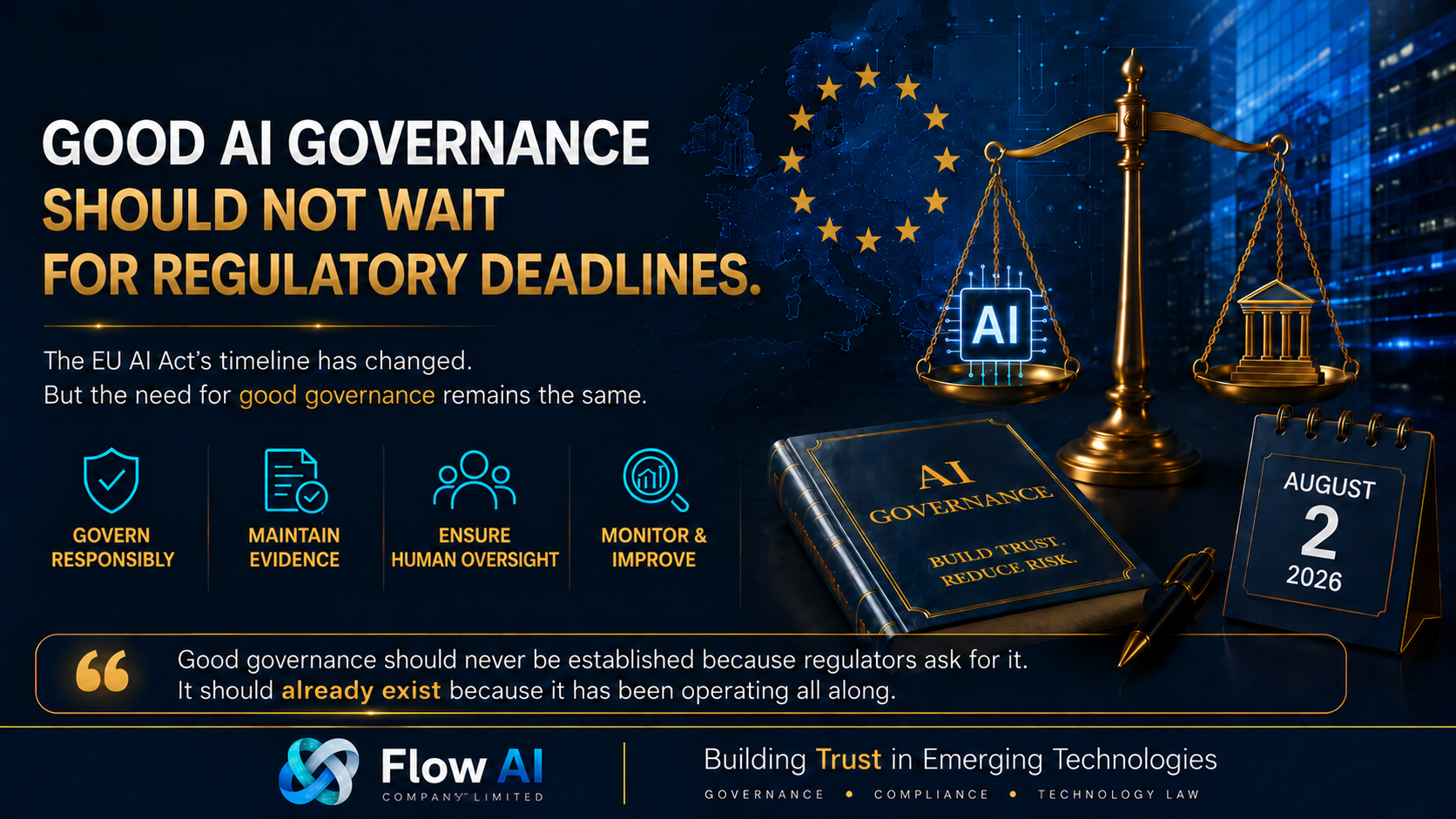
For several years, many organizations preparing for the EU AI Act viewed 2 August 2026 as a major milestone for compliance, particularly for high-risk AI systems.
However, following the European Union's Digital Omnibus initiative, parts of the implementation timeline for certain high-risk AI obligations have been adjusted to provide additional time for implementation.
Some organizations may interpret this as having more time before strengthening their AI governance.
Over the past several weeks, I have written about legal responsibility for AI-generated outputs, governance by design, AI failures as governance risks, and the importance of demonstrating due diligence after AI incidents.
The recent changes to the EU AI Act implementation timeline do not change these governance principles.
If anything, they reinforce them.
One of the most important contributions of the EU AI Act is not simply its compliance requirements.
It is its risk-based approach.
Rather than regulating every AI system equally, the Act recognizes that governance expectations should increase as the potential impact of AI increases.
Organizations should therefore not ask only:
"Is our AI system classified as High-Risk under the EU AI Act?"
They should also ask:
"If this AI system produces an incorrect output tomorrow, can we explain how it was governed today?"
That question remains relevant regardless of where an organization operates, when regulatory deadlines apply, or whether a particular AI system is formally classified as high risk.
Because when AI failures occur, regulators, customers, business partners, and courts rarely focus only on whether an organization complied with the minimum legal requirements.
They increasingly ask whether the organization governed AI responsibly.
Good AI Governance is therefore not simply about preparing for compliance.
It is about establishing governance, assigning accountability, maintaining evidence, implementing appropriate human oversight, and continuously monitoring AI throughout its lifecycle.
Regulatory timelines may change.
Technology will continue to evolve.
Neither changes the fundamental governance responsibility of organizations that choose to deploy AI.
Organizations that build governance to earn trust will already be prepared long before regulators ask them to prove it.
Looking back on my experience in compliance, one lesson has stayed with me.
Good governance should never be established because regulators ask for it. It should already exist because it has been operating all along.
In my view, organizations that treat AI Governance as a long-term business capability - not simply a compliance exercise - will be better positioned to earn trust from regulators, customers, business partners, and society.
For a deeper discussion, please watch the full 10-minute episode on YouTube: https://youtu.be/NXrvG4iRnpo