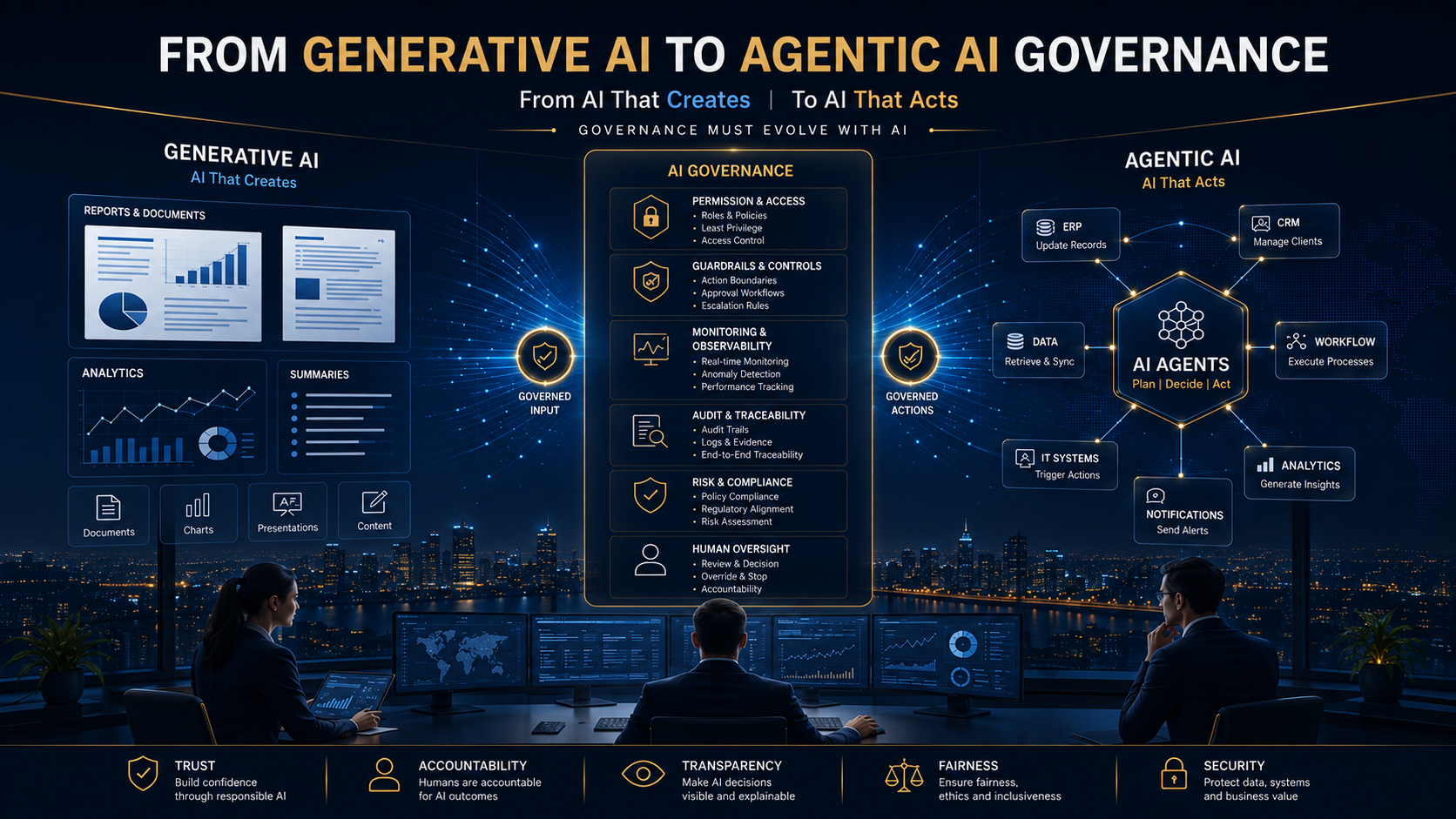
From Generative AI Governance to Agentic AI Governance
AI is evolving rapidly.
From my observation, many organizations are still exploring how Generative AI can improve productivity by creating content, summarizing information, and supporting decision-making.
However, the next frontier is already emerging.
Unlike traditional Generative AI, Agentic AI can take actions. They can access tools, execute workflows, and perform tasks with limited human intervention.
This changes the governance challenge entirely.
Consider a simple business scenario.
With Generative AI, an accountant can create an executive infographic from financial data in one minute instead of waiting for graphic design support.
With Agentic AI, the AI agent can collect financial data, generate the report, distribute it to executives, and trigger follow-up actions automatically.
The question is no longer whether the AI generated accurate content.
The question becomes:
- Was the agent authorized to access those systems?
- Should it be allowed to send reports automatically?
- Who can stop the agent during execution?
- Can every action be audited afterward?
This is where Agentic AI Governance begins.
Traditional AI Governance focuses on what AI can generate.
Agentic AI Governance must focus on what AI is allowed to do.
As AI becomes increasingly autonomous, organizations may need to govern:
- Tool permissions
- Memory management
- Human escalation controls
- Runtime monitoring
- Auditability
Agentic AI may become one of the most significant productivity multipliers in the modern workplace.
But as AI capabilities evolve, governance frameworks must evolve as well.
AI Governance should not be a static policy document.
It should be a living framework that adapts to the changing capabilities of AI technologies.
Sustainable AI Governance is not about restricting innovation.
It is about ensuring that innovation remains trustworthy, accountable, and aligned with organizational objectives as AI systems become increasingly autonomous.
The next evolution of AI Governance may already have begun.