When Can Foreign AI Laws Apply to a Thai Business?
A Thai company develops an AI recruitment system in Bangkok. A German employer uses it to evaluate candidates. The Thai provider has no EU office.
Could the EU AI Act still apply?
Yes—depending on its role and how the system is supplied and used. Headquarters location is not the only legal test.
Article 2 of the EU AI Act can cover non-EU providers placing AI systems on the EU market or putting them into service there. It can also cover certain providers and deployers outside the EU where AI outputs are used within the Union.
But being within scope does not mean every obligation applies to every AI system.
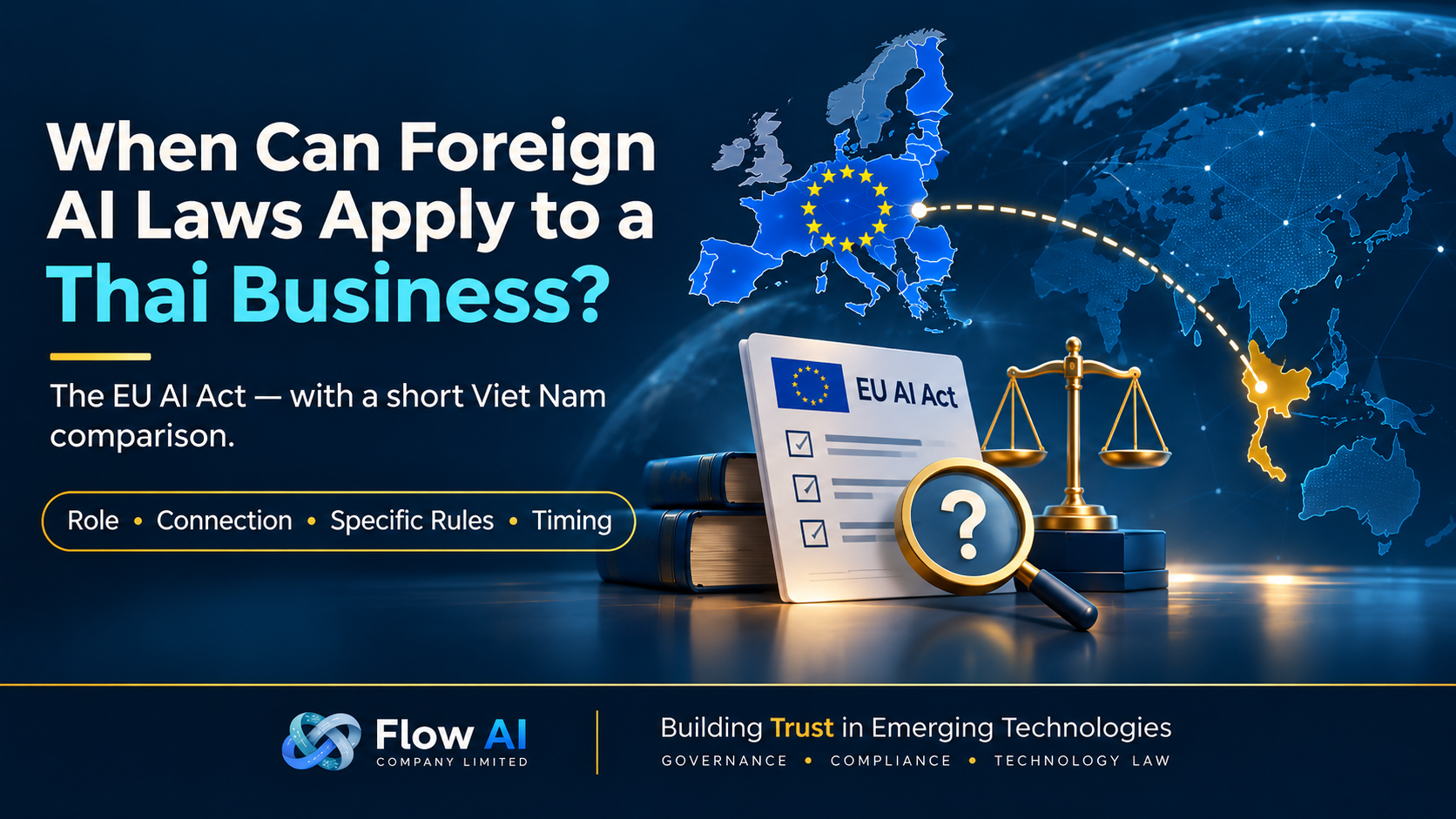
Four questions help executives and legal teams assess exposure:
1. Role: Are we a provider, deployer, or another regulated actor?
2. Connection: Is the system supplied or used in the EU, or is its output used there?
3. Specific rules: Does it fall within a regulated category, such as high-risk recruitment AI?
4. Timing: When do those particular obligations begin?
Under the amended EU timetable, relevant high-risk provisions for Annex III systems are scheduled to apply from 2 December 2027, and corresponding Annex I provisions from 2 August 2028. Other provisions already apply.
For certain non-EU high-risk AI providers, Article 22 requires an EU-based authorised representative once the relevant rules apply. This is not a universal obligation for Thai businesses.
Viet Nam offers a useful contrast. Its AI Law No. 134/2025/QH15 has its own territorial scope and requirements for certain foreign providers. The EU approach cannot simply be copied across jurisdictions.
The takeaway: Before asking how to comply with a foreign AI law, first establish whether it applies, in what capacity, and under which provisions.
A documented legal scoping assessment is a more reliable starting point than either ignoring foreign regulation or assuming every rule applies.
Legal research checked: 2 November 2026. General education, not legal advice.
Sources: EU AI Act (Reg. (EU) 2024/1689, Arts. 2, 6, 22; Annex III); Reg. (EU) 2026/1744; Viet Nam Law No. 134/2025/QH15.
For a deeper discussion, please watch the full 12-minute episode on YouTube: https://youtu.be/c2qULGlUJgw