When AI Speaks, Who Is Legally Responsible?
As both a lawyer and an AI Governance advisor, one legal question has been on my mind recently:
Who is legally responsible when AI generates false information?
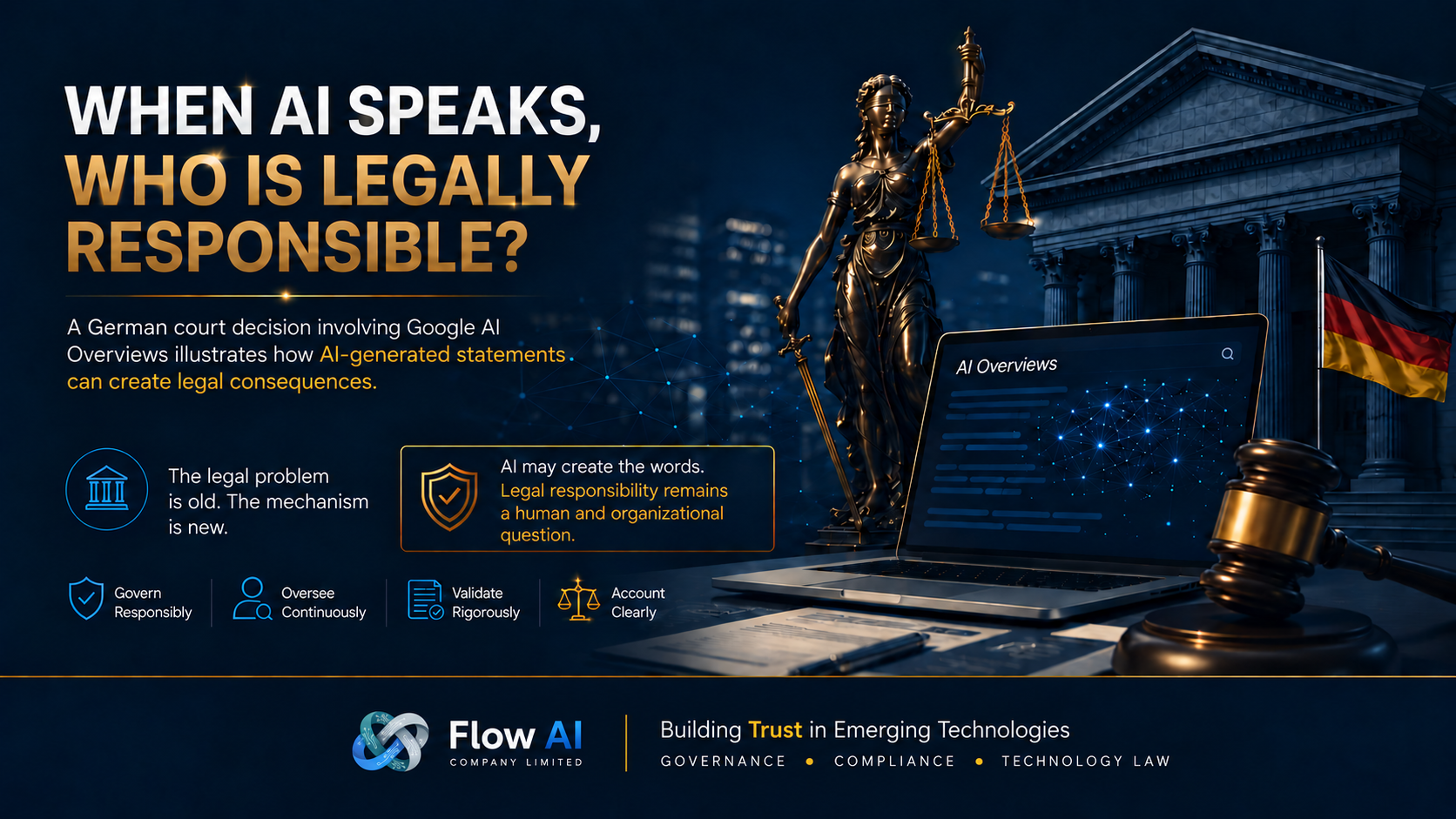
A recent Reuters report highlighted an important legal development in Germany. The Regional Court of Munich held that Google may be held directly liable for false factual statements generated by its AI Overviews.
The court distinguished AI-generated summaries from traditional search results because the AI creates its own synthesized statements rather than merely displaying third-party content.
Google has appealed the decision.
For organizations deploying AI, the lesson extends far beyond one court decision.
If AI-generated outputs can create legal liability, then AI Governance is no longer simply about ethics or regulatory compliance.
It becomes an essential component of organizational risk management.
From my perspective, this case is significant for a much broader reason.
It suggests that courts are beginning to view generative AI outputs not merely as technological functions, but as statements capable of creating legal consequences.
From a legal perspective, this is not an entirely new principle.
For centuries, the law has recognized that individuals and organizations may be held responsible for publishing false information that causes harm.
What is changing is not the legal principle itself, but the application of that principle to AI-generated content.
AI can generate content. Only organizations can assume responsibility for its consequences.
Technology evolves rapidly.
Legal principles evolve more gradually.
But one principle has remained remarkably consistent for centuries.
When information causes harm, the law ultimately asks who should bear responsibility.
Generative AI has not changed that question.
It has only made answering it more difficult.
Source: Reuters, "Google to appeal German court ruling assigning liability for AI Overviews false claims" June 2026
For a deeper discussion, please watch the full 13-minute episode on YouTube: https://youtu.be/qxpovGxeuVM