AI Hallucinations in 2026: The Technology Has Changed. The Governance Challenge Has Not.
Since Generative AI became widely available in late 2022, AI hallucinations have been recognized as one of its most significant limitations.
When the first high-profile legal cases emerged in 2023, many viewed them as part of the learning curve. The technology was new, and professionals were still discovering both its capabilities and its limitations.
Yet here we are in 2026, and similar incidents continue to occur—even in legal practice, where accuracy is fundamental.
This raises an important question:
Why are AI hallucinations still finding their way into official legal documents?
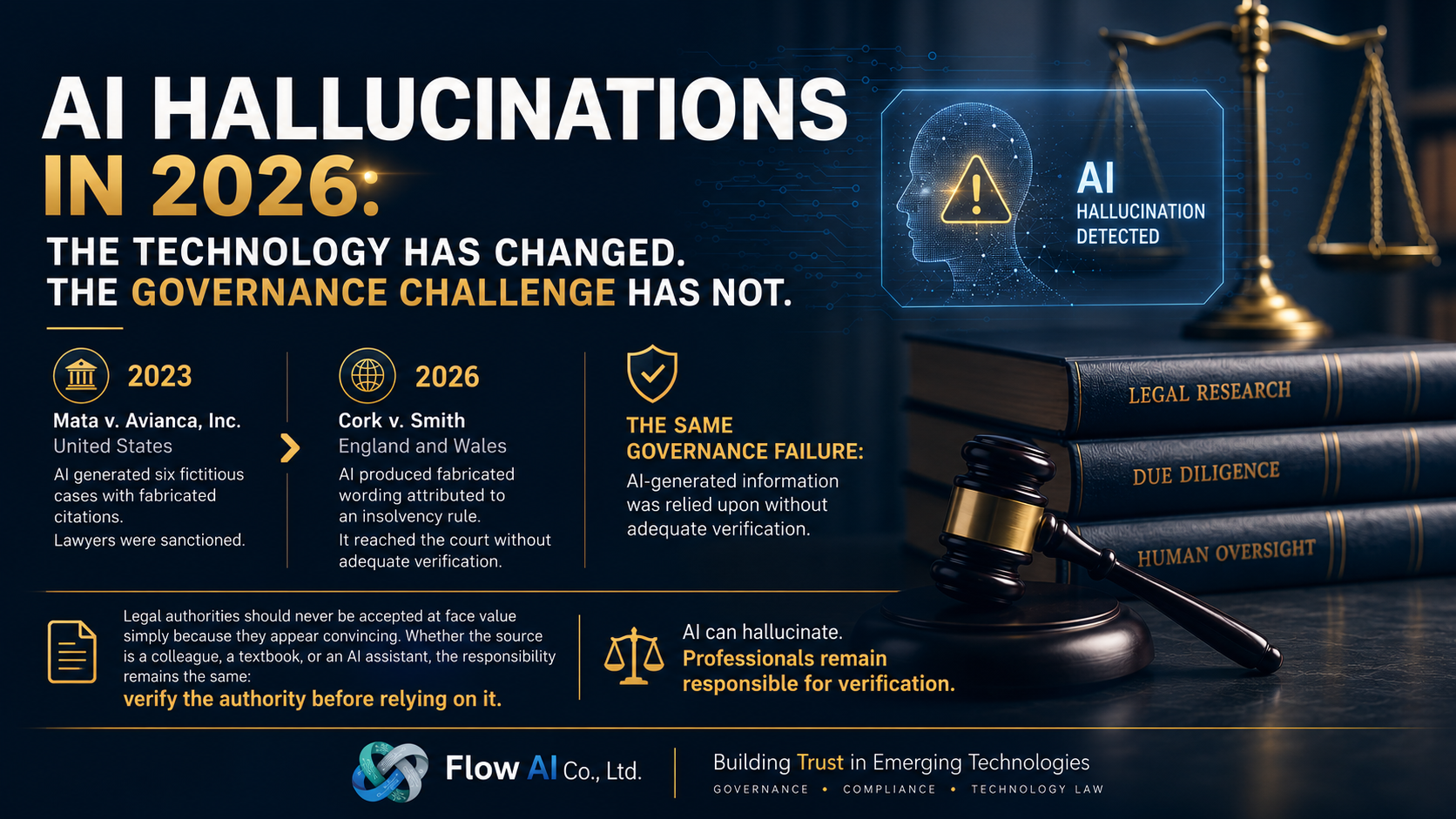
In Mata v. Avianca, Inc. (United States, 2023), lawyers submitted a court filing containing six fictitious cases generated by AI. The court later sanctioned the lawyers after those authorities proved to be entirely fabricated.
Three years later, in Cork v. Smith (United Kingdom, 2026), AI generated a reference to an insolvency rule that simply did not exist. The incorrect citation was included in correspondence to the court, prompting criticism of the firm's verification and supervision processes.
The technology had evolved.
The legal systems were different.
The law firms were different.
But the governance challenge remained remarkably similar: AI-generated information was relied upon without adequate human verification.
These incidents were not simply failures of legal research. They were failures of governance—specifically, failures to verify AI-generated information before it became part of an official legal process.
As a lawyer, I was taught that legal authorities should never be accepted at face value simply because they appear convincing. Whether the source is a colleague, a textbook, or now an AI assistant, the responsibility remains the same: verify the authority before relying on it.
AI should not change that professional discipline.
The same principle applies beyond the legal profession. Organizations should establish governance processes that verify AI-generated outputs before they influence legal, financial, regulatory, or business decisions.
Frameworks such as the NIST AI Risk Management Framework emphasize continuous measurement and monitoring of AI systems throughout their lifecycle, while ISO/IEC 42001 encourages organizations to establish governance processes that regularly evaluate AI systems and the effectiveness of their controls.
Ultimately, AI should enhance professional judgment—not replace it.
Organizations that gain the greatest long-term value from AI will not necessarily be those using the most advanced models. They will be those with disciplined AI Governance and AI Assurance processes that verify AI-generated outputs before they become business, legal, or regulatory decisions.
The court does not sanction AI for hallucinating. It sanctions professionals for failing to verify.
For a deeper discussion, please watch the full 13-minute episode on YouTube: https://youtu.be/mfALiZ7Hmm4