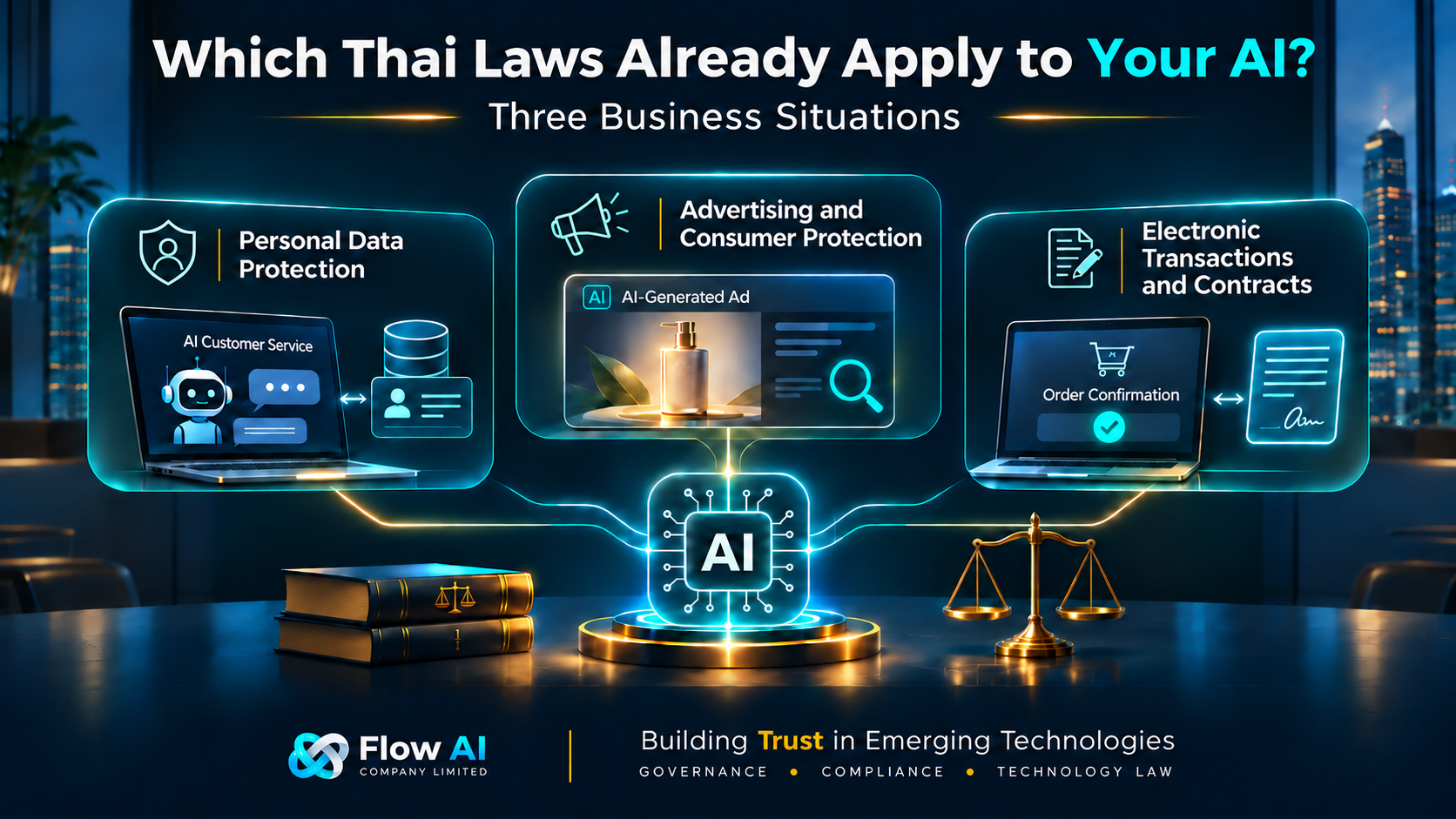
Which Thai Laws Already Apply to Your AI? Three Business Situations
Imagine a Thai company using AI in three ways: a customer-service chatbot accessing customer records, an AI-generated advertisement, and automated online order confirmations.
All three involve AI. But do they raise the same legal questions?
1. Personal Data Protection
When a chatbot processes names, purchase histories, or customer messages, Thailand’s Personal Data Protection Act (PDPA) may apply.
Organizations should consider the purpose and lawful basis of processing, data shared with providers, access controls, and retention. Consent is not the only possible lawful basis; the appropriate basis depends on the facts.
2. Advertising and Consumer Protection
Suppose an AI-generated advertisement shows a product feature that does not exist.
The question is whether the advertisement is misleading under Thailand’s Consumer Protection Act and any applicable sector-specific rules—not whether AI created it.
Checking factual claims before publication is a sensible control.
3. Electronic Transactions and Contracts
Automated order confirmations may have contractual consequences.
Thailand’s Electronic Transactions Act recognizes that certain contracts formed through automated systems cannot be denied validity merely because no human participated in each step. Authority, intention, message content, and circumstances still matter.
What Should Organizations Do?
Map each AI use case to its activity:
- What data does it process?
- Who may be affected?
- What actions can it take?
- Which laws and sector rules may apply?
In July 2026, the Thai government reported continued work on proposed AI-specific legislation. A proposal is not a law in force. (Legal research current as at 29 October 2026.)
Key lesson: Legal responsibilities are often attached to what an organization does with AI—not simply to the AI label.
General educational information, not legal advice for a specific situation.
For a deeper discussion, please watch the full 10-minute episode on YouTube: https://youtu.be/teQ7i7OMgek
Flow AI | Building Trust in Emerging Technologies