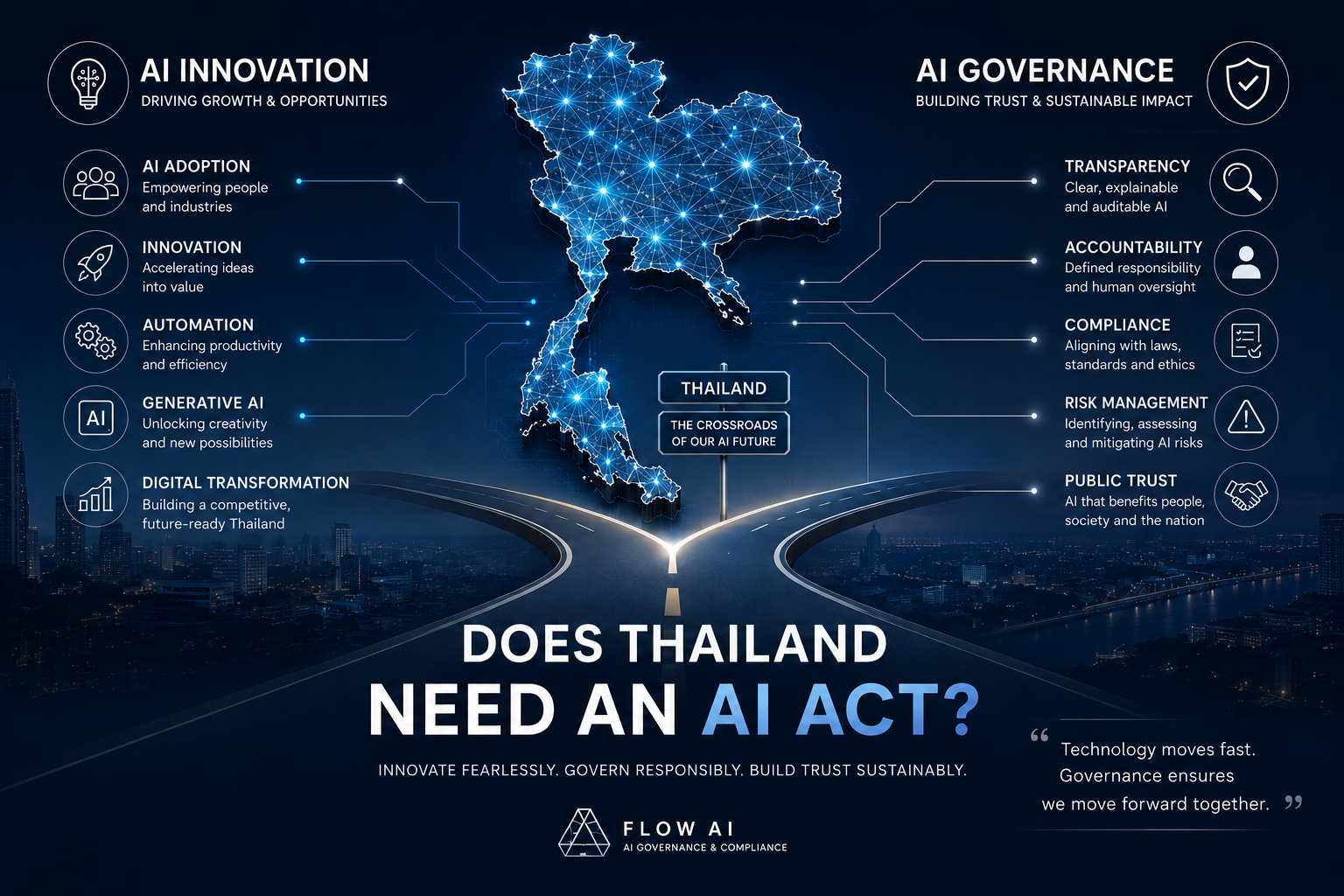
Does Thailand Need an AI Act?
Recently, there has been significant public discussion surrounding the TH-AI Passport initiative, which aims to expand access to premium Generative AI tools for millions of Thai citizens.
Personally, I believe that AI will become an essential skill across virtually every profession. Learning how to work with AI is no longer optional—it is becoming a necessity.
However, promoting AI adoption alone may not be enough.
At the same time, we should also be discussing AI Governance and Compliance.
The impact of AI extends far beyond individual users. It can affect:
• Individuals and data subjects
• Organizations and businesses
• Society and the economy
• National security
• Environmental sustainability through the increasing demand for computational resources
Over the past few years, countries around the world have accelerated the development of AI-related laws, regulations, governance frameworks, and policy guidelines. Examples include the EU AI Act, China's regulatory framework for Generative AI services, Singapore's AI Governance initiatives, and various AI-related laws and regulations emerging across U.S. states.
In Thailand, organizations such as ETDA and other government agencies have already introduced AI Governance guidelines and best practices. These are important first steps in the right direction.
However, in 2026, we are rapidly moving beyond the era of Generative AI and entering the era of Agentic AI—where AI systems are increasingly capable of planning, making decisions, and taking actions with greater autonomy.
Perhaps the key question is no longer simply:
"How can we encourage more people to use AI?"
But also:
"Should Thailand establish a clearer national AI governance framework?"
And in the longer term:
"Is it time for Thailand to consider a Thailand AI Act that aligns with both local contexts and international standards?"
I would be interested to hear perspectives from policymakers, business leaders, legal professionals, technologists, academics, and anyone involved in shaping Thailand's AI future.
For a deeper discussion, please watch the full 16-minute episode on YouTube: https://youtu.be/u4HFiuwx_6A