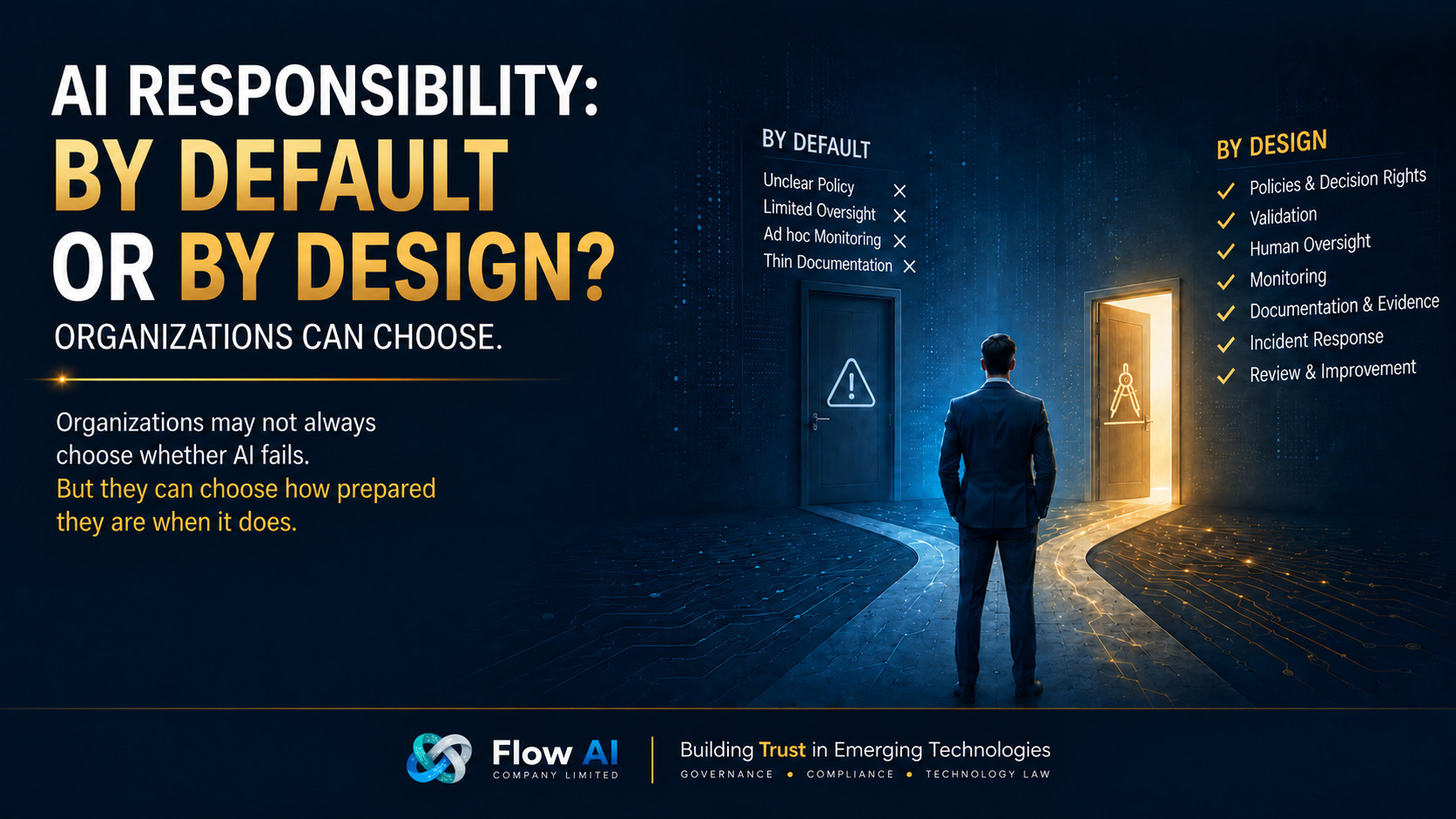
AI Responsibility: By Default or By Design? Organizations Can Choose.
Recently German court decision raises an important question.
If organizations may be held responsible for AI-generated outputs...
Can they do anything about it?
As a lawyer and AI Governance Advisor, I believe the answer is yes.
Organizations have two choices.
1. Responsibility by Default
Organizations deploy AI quickly.
Employees use whatever prompts they like.
There is no acceptable AI use policy:
- No testing
- No validation
- No monitoring
- No human oversight
- No documentation
When something goes wrong, the organization is forced to assume responsibility without having deliberately prepared for it.
In other words, responsibility arises by default - not because it was planned, but because no governance framework was in place.
2. Responsibility by Design
Organizations deliberately build governance into the AI lifecycle.
Examples include:
- Acceptable AI Use Policy
- Human Oversight
- Prompt Standards
- Validation Procedures
- Approval Workflows
- Monitoring and Logging
- Incident Reporting
- Audit Trails
- Periodic Governance Reviews
When AI goes wrong, the organization has already established governance mechanisms to manage the situation.
Responsibility is not avoided.
It is anticipated, documented, and intentionally managed.
The question is no longer whether organizations will be held responsible for AI.
Increasingly, they will.
The real question is whether that responsibility will arise by default, after an incident occurs or by design, through governance decisions made before AI is deployed.
Organizations may not always choose whether AI fails.
But they can choose how prepared they are when it does.
For a deeper discussion, please watch the full 12-minute episode on YouTube: https://youtu.be/ytV44DlrEpE