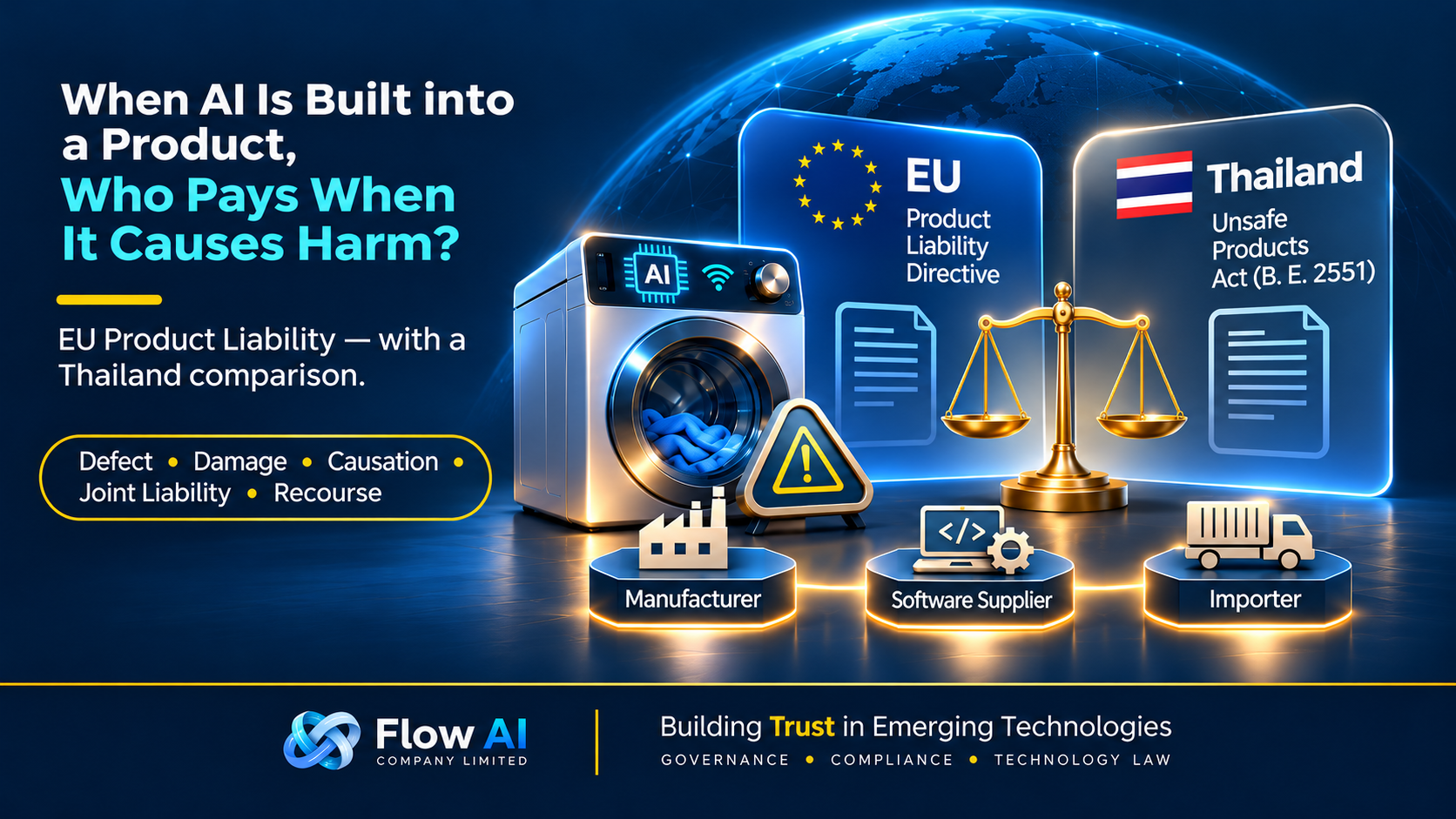
When AI Is Built into a Product, Who Pays When It Causes Harm?
Imagine a Thai manufacturer sells an AI-enabled home appliance in the EU. A safety function fails, and a customer is injured.
The software developer, hardware supplier, manufacturer, and EU importer all contributed to the product. But who may have to compensate the customer—and who ultimately bears the cost?
The answer depends on legal roles, product defects, damage, and causation—not simply on who wrote the AI code.
Under the EU’s revised Product Liability Directive, software—including AI software—expressly qualifies as a product, whether stand-alone or integrated into hardware. The new rules apply to products placed on the EU market or put into service from 9 December 2026, through the relevant Member State’s implementing law.
Several businesses may be liable for the same harm. The Directive provides for joint and several liability, while a business that pays compensation may seek recourse from other liable parties under applicable national law. Commercial contracts cannot remove an injured person’s statutory rights.
This is no-fault liability, but not automatic compensation: qualifying harm, defect, and causation still matter. Software updates, related services, and post-sale modifications can also affect the analysis.
Thailand’s Unsafe Products Act B.E. 2551 provides for joint liability of operators in qualifying cases involving unsafe products. However, its treatment of stand-alone software should not be assumed equivalent to the EU framework. Cross-border cases require separate analysis of applicable law and jurisdiction.
For executives, the practical priorities are to identify parties across the product chain, understand who controls changes and updates, preserve relevant evidence, and review contractual recourse and insurance.
Crucially, good documentation does not, by itself, defeat no-fault product liability. It helps clarify defects, causation, potential defences, and the allocation of costs.
The key question is not only whether an AI-enabled product works—but who answers when it does not.
For a deeper discussion, please watch the full 9-minute episode on YouTube: https://youtu.be/Hw-tEw4Kjxc