AI Hallucinations in 2026: Well-Designed Prompts Are One of the Governance Controls
Over the past year, countless articles have shared techniques for writing better prompts to improve AI responses.
While those techniques are undoubtedly useful, I believe there is another perspective worth considering.
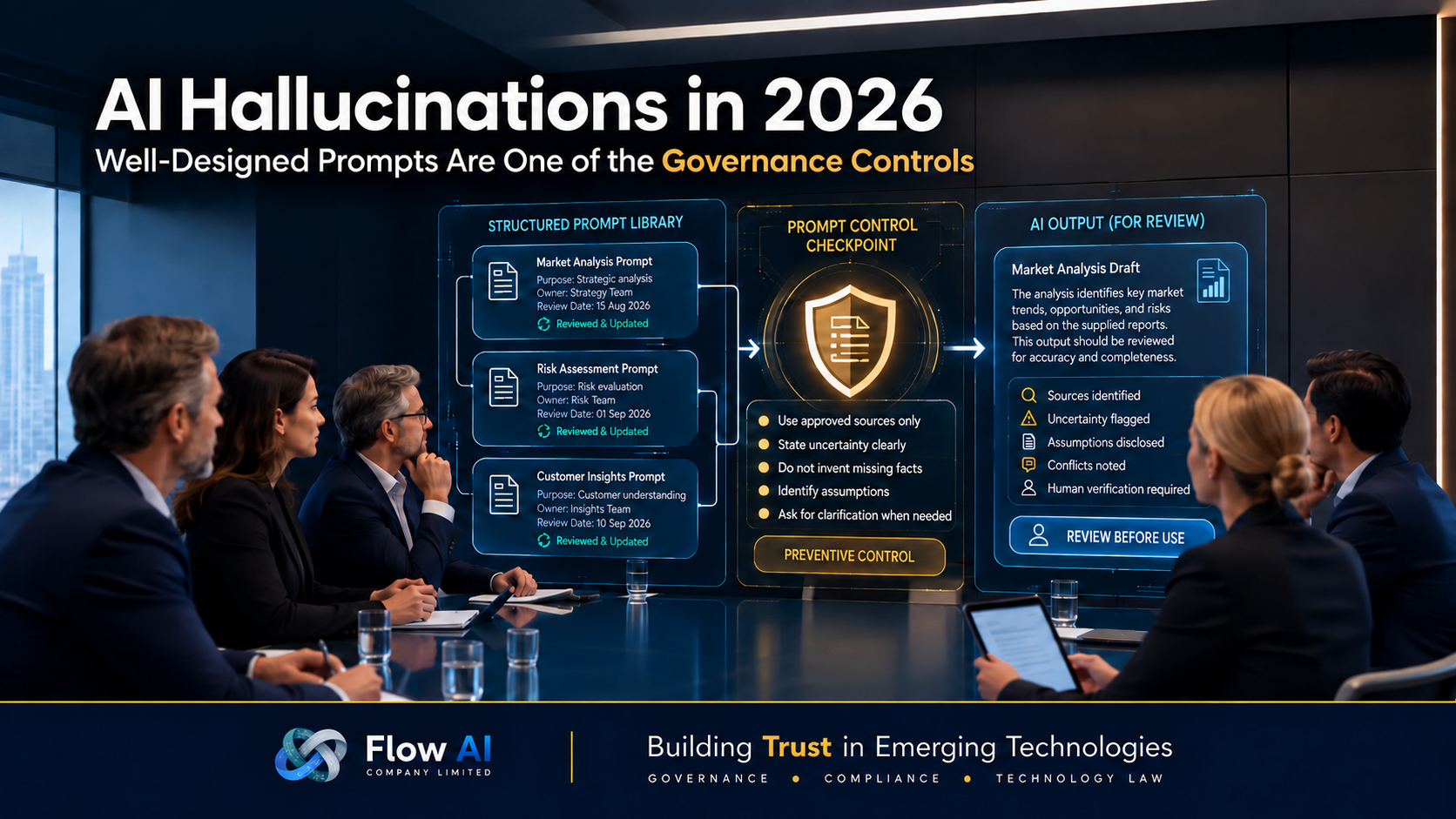
Well-designed prompts are one of the governance controls for AI systems.
In other words, prompting is not merely about getting better answers. It is also about managing AI-related risks before an AI system generates its response.
For example, a well-designed prompt may instruct an AI system to:
- state when it is uncertain rather than presenting speculation as fact;
- rely only on available information instead of inventing missing details;
- identify assumptions where appropriate; or
- request additional information when the user's question lacks sufficient context.
These instructions do not guarantee that hallucinations will never occur.
However, they can significantly reduce the likelihood of misleading or fabricated responses.
From my own experience in operations management, I have worked in both the healthcare industry and the professional AV distribution business.
Although both roles fell under "operations," the governance, policies, and internal practices required were significantly different.
For example, HR policies and internal communication in a healthcare organization must support doctors, nurses, and other licensed healthcare professionals. In contrast, a professional AV distributor typically works with technical engineers, sales specialists, and technology-focused teams, requiring a different management approach.
The same principle applies to AI Governance.
There is no single prompt that is suitable for every organization, every business function, or every AI use case.
Well-designed prompts should be tailored to the specific objectives, risks, and operational context in which AI is being used. They should also be periodically reviewed and refined as business processes, AI capabilities, and organizational requirements evolve.
In that sense, prompt design is not simply an exercise in writing better instructions. It is part of designing governance controls that are appropriate for the environment in which AI operates.
Of course, prompting alone is not enough.
AI models evolve. Knowledge changes. Business requirements change. Even carefully designed prompts cannot eliminate every risk.
That is why AI Governance is not only about using AI effectively, but also about implementing multiple layers of controls that work together to improve reliability and trust.
In my view, organizations should begin to see prompt design not merely as a productivity technique, but as an integral part of responsible AI governance.
Well-designed prompts are one of the governance controls. They reduce risk, but they do not eliminate it.
For a deeper discussion, please watch the full 11-minute episode on YouTube: https://youtu.be/DF8YskyEjPQ