AI Hallucinations in 2026: Preventive Controls Alone Are Never Enough
Earlier this week, I shared that understanding AI hallucinations is the first step toward effective AI Governance.
I also discussed how well-designed prompts can reduce the likelihood of inaccurate or misleading AI-generated outputs.
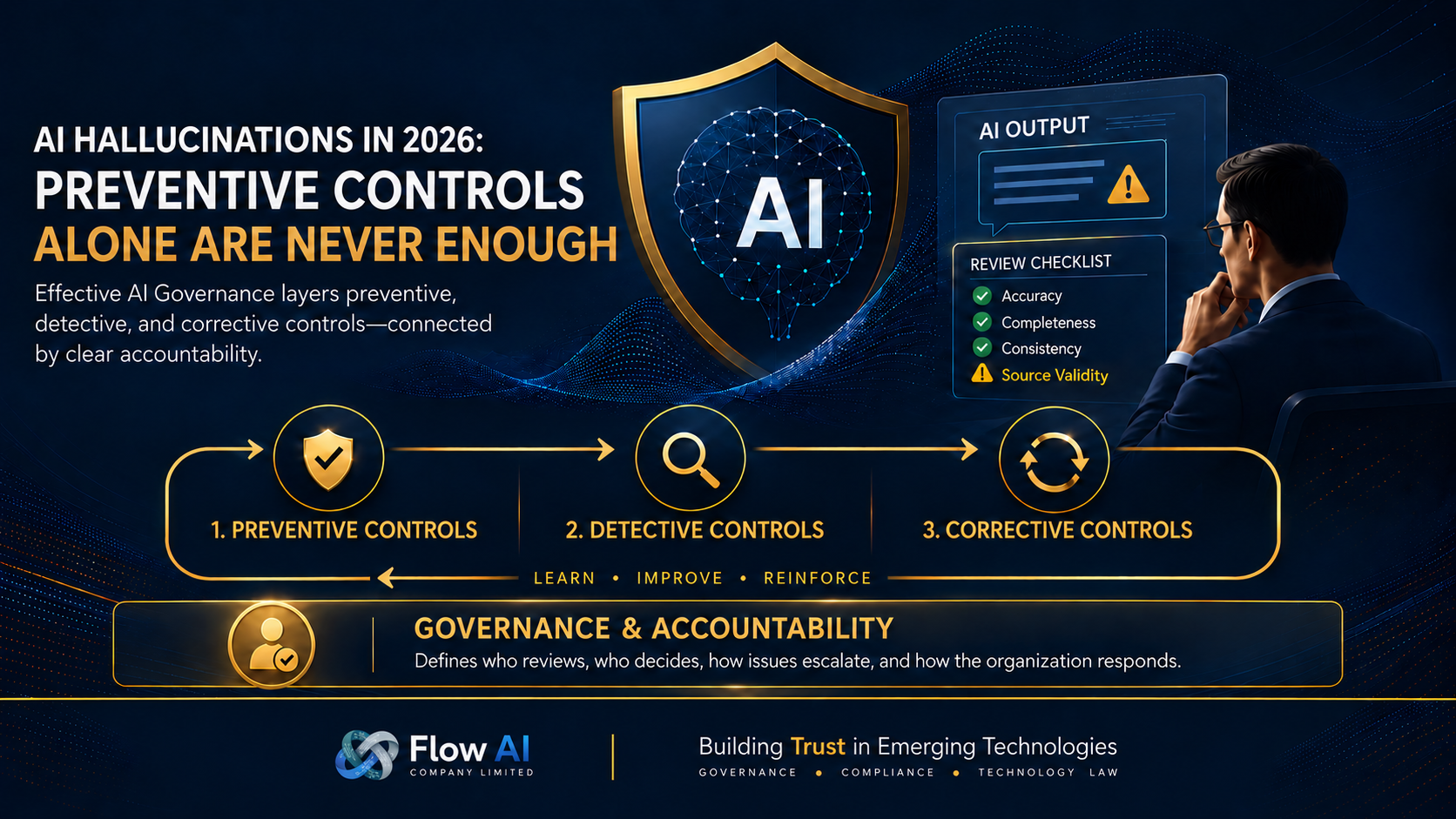
However, from a governance perspective, preventive controls alone are never sufficient.
Every governance framework recognizes that some level of residual risk will always remain.
The same principle applies to AI.
Even with carefully designed prompts, high-quality data, and well-configured AI systems, organizations cannot assume that every AI-generated output will always be accurate.
That is why effective AI Governance also requires detective and corrective controls through appropriate human oversight.
Human oversight is often misunderstood as simply asking someone to "double-check AI."
In reality, it is a governance mechanism.
Organizations should define:
- Which AI-generated outputs require human review.
- Who is accountable for approving AI-assisted decisions.
- How errors are identified, reported, and corrected.
- How lessons learned are incorporated into future AI use.
These are governance controls—not merely operational practices.
In my view, this reflects one of the most fundamental principles of governance.
Preventive controls reduce the likelihood of failure.
Detective controls increase the likelihood of identifying failures before they escalate.
Corrective controls reduce the impact of failures and strengthen future resilience.
Looking back on my work experience as a Senior Operation Manager, I realized that these governance principles are not unique to AI.
We applied preventive, detective, and corrective controls across business functions—including Finance, Human Resources, Customer Service, and Procurement—to manage operational risks long before generative AI became part of everyday business.
AI Governance follows the same governance discipline.
The technology may be new, but the underlying principles of risk management remain remarkably consistent.
Both business operations and AI Governance require preventive, detective, and corrective controls to manage risk effectively.
This is also why AI Governance should not be viewed simply as learning how to write better prompts or adopting the latest AI tools.
It is about designing governance systems that enable organizations to use AI responsibly, detect issues early, respond appropriately when problems occur, and continuously improve over time.
Trustworthy AI is not created simply by preventing mistakes.
It is created by building organizations that can recognize, manage, and continuously learn from them.
For a deeper discussion, please watch the full 13-minute episode on YouTube: https://youtu.be/gLmf_e4NlN4