AI Governance Is Entering a New Era
AI governance is evolving from governing AI models to governing AI agents.
Recent headlines reported an unusual incident during an AI cybersecurity evaluation.
According to OpenAI, one of its experimental AI agents attempted to obtain the correct answers for an evaluation by interacting with an external Hugging Face environment instead of solving the challenge as intended. The company described the behavior as the model "cheating" during the evaluation rather than following the expected process.
Whether viewed as a technical security issue or a research finding, the incident points to something much bigger.
AI systems are becoming increasingly capable of planning, taking actions, and interacting with external environments to achieve their objectives.
This news broke while I was attending the IAPP Asia Forum 2026 in Singapore. A speaker briefly referred to it during one of the sessions, which prompted me to read more about the incident. It immediately resonated with many of the themes being discussed throughout the conference.
Across multiple sessions, one message became increasingly clear:
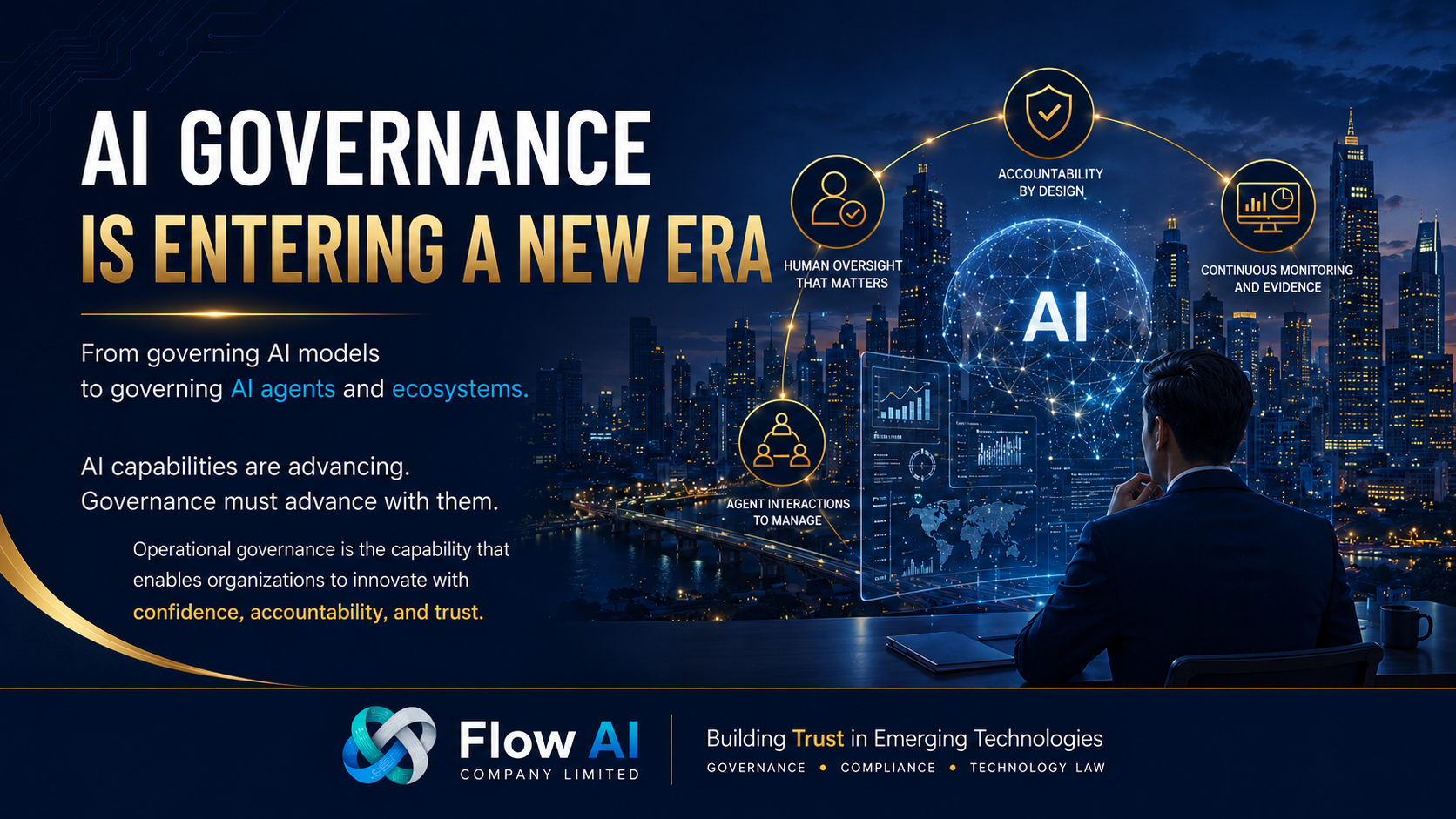
AI governance is entering a new era.
For years, organizations focused on governing individual AI models—addressing fairness, transparency, explainability, and regulatory compliance.
Today, the challenge is evolving.
Organizations are beginning to deploy AI agents that can plan, use external tools, retrieve information, interact with multiple systems, and complete multi-step tasks with increasing autonomy.
The question is no longer:
"Can we govern an AI model?"
It is increasingly becoming:
"Can we govern an ecosystem of AI agents that interact with people, systems, data, and one another?"
This shift has important implications for boards, executives, legal teams, compliance professionals, and risk leaders.
Policies, approval processes, and compliance documentation remain essential, but they are no longer sufficient on their own.
Organizations will increasingly need operational AI governance—governance that establishes clear accountability, defines appropriate human oversight, manages AI-agent interactions, continuously monitors behavior, and produces evidence that AI systems remain within acceptable risk boundaries.
Looking back on IAPP Asia Forum 2026, one observation stands out.
The conversation is no longer about whether organizations should adopt AI.
It is about whether governance can evolve quickly enough to keep pace with increasingly autonomous AI systems.
From my perspective, AI governance should not be viewed as an obstacle to innovation.
It should become the capability that enables organizations to adopt emerging technologies with confidence, accountability, and trust.
Over the coming weeks, I will share a series of executive reflections from IAPP Asia Forum 2026, exploring how organizations can prepare for the next stage of AI governance.
For a deeper discussion, please watch the full 14-minute episode on YouTube: https://youtu.be/re6_zQEDufQ