AI Governance Does Not End at Deployment
Many organizations spend significant time evaluating AI before deployment.
They assess accuracy, fairness, robustness, security, and other important factors to ensure the system is ready for production.
But an important question often remains:
What happens after deployment?
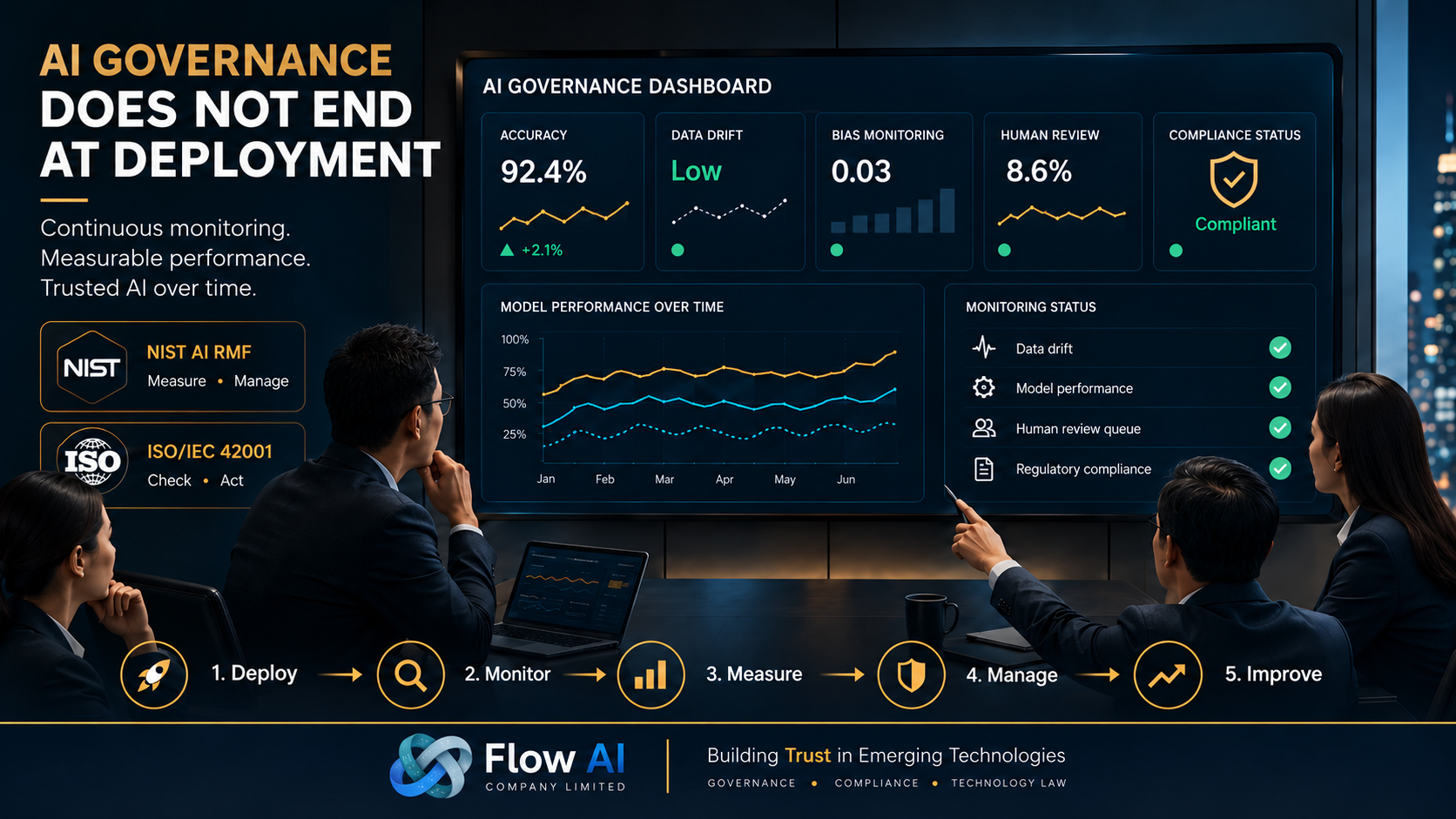
AI Governance does not end when an AI system goes live.
Just as organizations regularly review financial controls, cybersecurity, and regulatory compliance, AI systems also require ongoing oversight throughout their operational lifecycle.
This principle is reflected in leading governance frameworks. The Measure and Manage functions of the NIST AI Risk Management Framework, as well as the Check and Act phases of ISO/IEC 42001, emphasize that organizations should continuously evaluate AI performance, identify emerging risks, and improve governance over time.
In practice, organizations may establish governance policies that define when AI systems should be reviewed. Reviews may occur periodically—such as every few months based on business needs and risk levels—or whenever significant events occur, including major model updates, changes in data sources, unexpected performance degradation, customer complaints, or regulatory changes.
In many ways, managing AI is no different from managing people.
From my experience working as an HR Business Partner, I have learned that successful organizations do not stop managing performance after hiring the right people.
When a new employee joins an organization, they complete onboarding, training, and competency assessments before beginning their role.
However, organizations do not assume that performance will remain optimal forever. Managers continue to review work quality, provide feedback, conduct performance evaluations, and address issues when necessary.
AI systems deserve the same level of governance.
A model that performs well today may behave differently tomorrow as data evolves, business environments change, or user behavior shifts.
Responsible AI is therefore not achieved through a single successful deployment.
It is achieved through continuous monitoring, measurement, and improvement.
Because trust in AI is not built at the moment of deployment.
It is earned through consistent governance over time.
Watch the full 13-minute episode on YouTube: https://youtu.be/ZjQQoKLJWIU