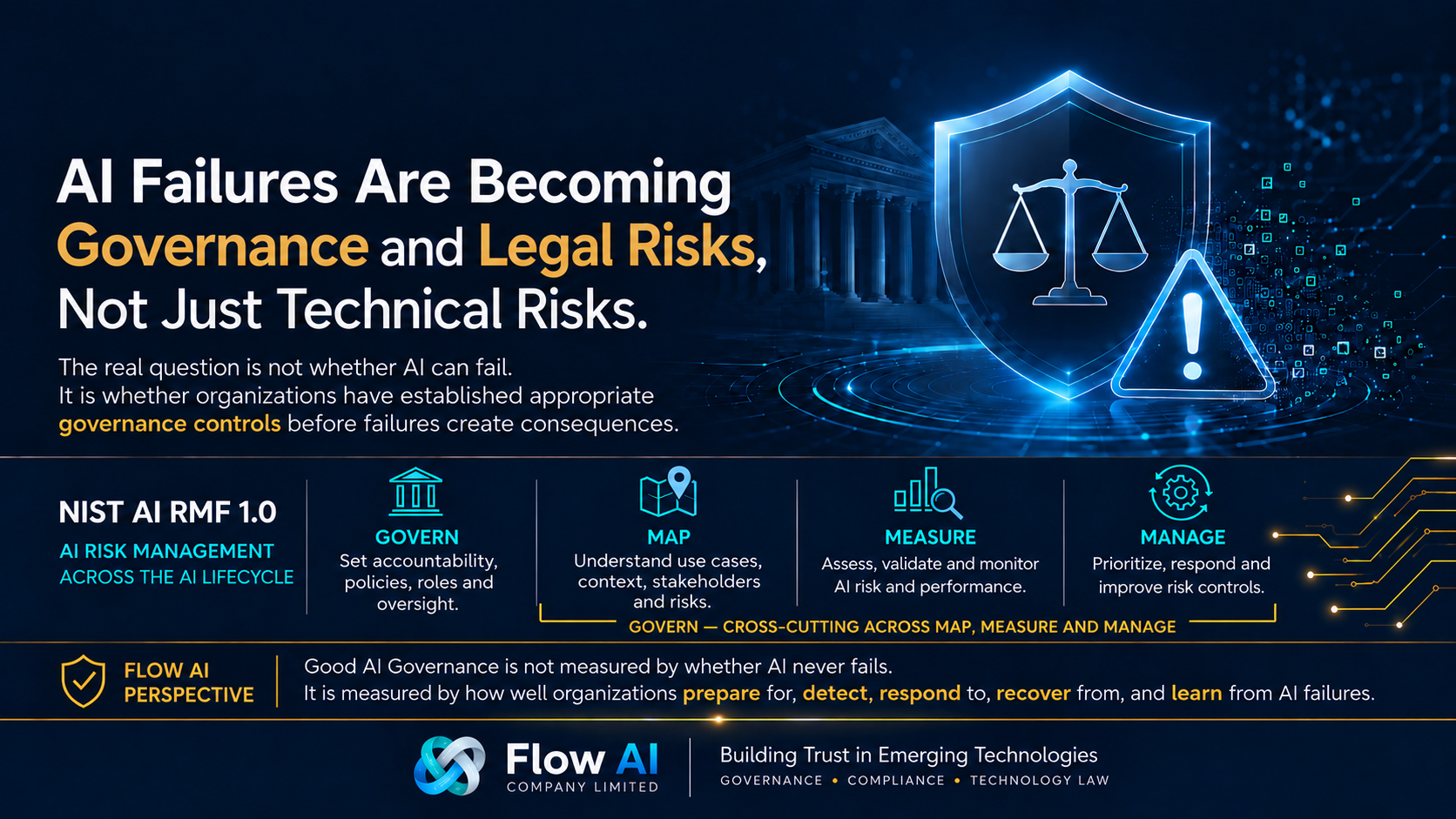
AI Failures Are Becoming Governance and Legal Risks, Not Just Technical Risks.
For the past few years, AI failures have largely been viewed as technical problems to be solved by better models, better prompts, or better engineering.
Those efforts remain important.
But as a lawyer and AI Governance Advisor, I believe the conversation is changing.
As organizations increasingly rely on Generative AI, AI-powered automation, and Agentic AI to generate content, provide recommendations, and perform autonomous tasks, AI failures are no longer only technical issues.
They are becoming governance risks.
And in some circumstances, they may also become legal risks.
An AI-generated statement that appears factual but is incorrect, an automated recommendation that leads to poor decisions, or an AI system that operates without appropriate human oversight may result in financial loss, regulatory scrutiny, contractual disputes, or reputational damage if organizations rely on those outputs without appropriate governance controls.
The AI itself does not bear responsibility.
Organizations do.
That is why the discussion should move beyond who is responsible after an AI failure to how organizations govern AI before failures occur.
AI Governance should not focus solely on improving model performance.
It should also establish governance controls that reduce the likelihood of AI failures, detect them when they occur, and respond appropriately.
In practice, AI Governance should extend across the entire AI lifecycle. The NIST AI Risk Management Framework (AI RMF) provides a useful structure:
Govern — Establish governance structures, policies, roles, accountability, and oversight.
Map — Understand AI use cases, business context, stakeholders, and potential risks.
Measure — Assess, validate, monitor, and evaluate AI risks and system performance.
Manage — Prioritize, respond to, monitor, and continuously improve AI risk management activities.
No governance framework can eliminate every AI failure.
But good governance can significantly reduce both the likelihood of failures and their potential impact.
AI technology will continue to improve.
Yet from a governance perspective, the more important question is not whether AI systems can fail.
It is whether organizations have established appropriate governance controls before those failures create business or legal consequences.
AI failures remain technical challenges.
Their consequences are increasingly becoming governance responsibilities.
Good AI Governance is not measured by whether AI never fails. It is measured by how well organizations prepare for, detect, respond to, recover from, and learn from AI failures when they occur.
For a deeper discussion, please watch the full 13-minute episode on YouTube: https://youtu.be/mX_3VM0RbQM