When Selecting AI, What Matters More: Capability or Trustworthiness?
A procurement team is evaluating several Large Language Model (LLM) vendors.
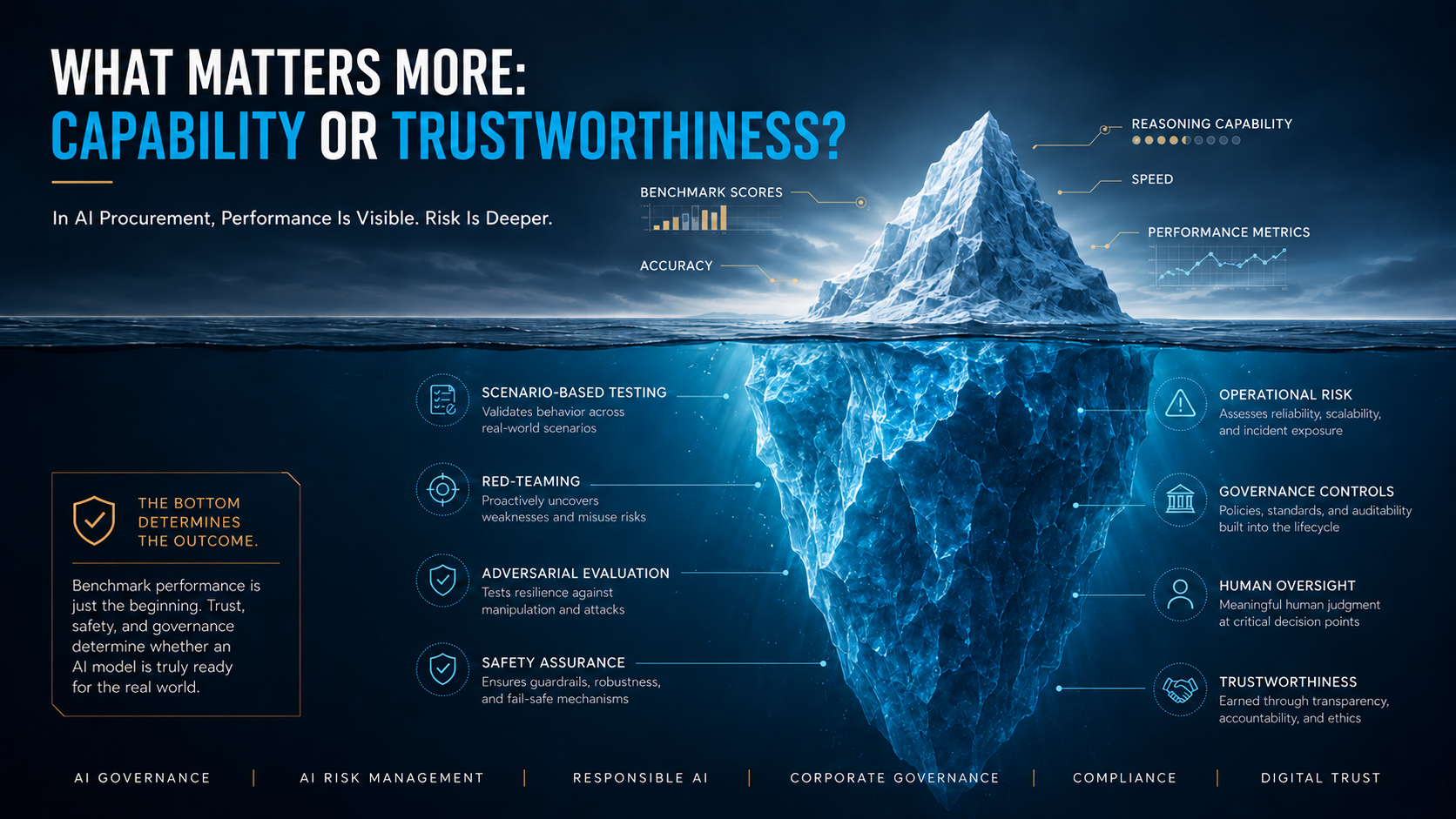
One vendor delivers outstanding benchmark scores and appears to outperform competitors in reasoning and language tasks. However, during due diligence, the team discovers that the vendor cannot provide evidence of scenario-based safety testing, red-teaming exercises, or adversarial evaluations.
Should the organization still select this model?
From an AI Governance perspective, the answer may be: "Not yet."
Benchmark scores demonstrate capability. They do not necessarily demonstrate trustworthiness.
A model may perform exceptionally well in controlled testing environments while behaving differently when exposed to real-world conditions, unexpected inputs, or attempts to bypass safety guardrails.
This is where principles aligned with NIST ARIA become relevant. Organizations should evaluate AI systems not only for performance, but also for how they behave in realistic operational scenarios and foreseeable misuse situations.
The strongest argument against selecting the vendor is simple:
Without scenario-based evaluations and red-teaming evidence, the organization cannot adequately assess operational risk.
Decision-makers may know how capable the model is, but they do not know how resilient, reliable, or safe it will be when deployed in production.
In practice, a slightly lower-performing model with robust safety testing may present a lower organizational risk than a higher-performing model whose real-world behavior remains largely unverified.
Throughout my career in HR, Legal, and Business Management, I have learned that capability alone rarely determines long-term success. Trust is often the deciding factor.
This case study reminded me of my experience as an HR Business Partner.
In recruitment, we do not hire solely based on technical skills. We also assess integrity, learning agility, growth mindset, and cultural fit. The most technically capable candidate is not always the best long-term hire.
The same principle applies to AI procurement.
The highest-performing AI model is not always the most suitable choice if its real-world risks remain insufficiently understood.
As AI adoption accelerates, governance leaders should remember:
Capability creates value.
Trustworthiness creates confidence.
Sustainable AI adoption requires both.
The goal is not to deploy the smartest AI.
The goal is to deploy AI that organizations can trust.