Can an AI Agent Bind Your Company to a Contract?
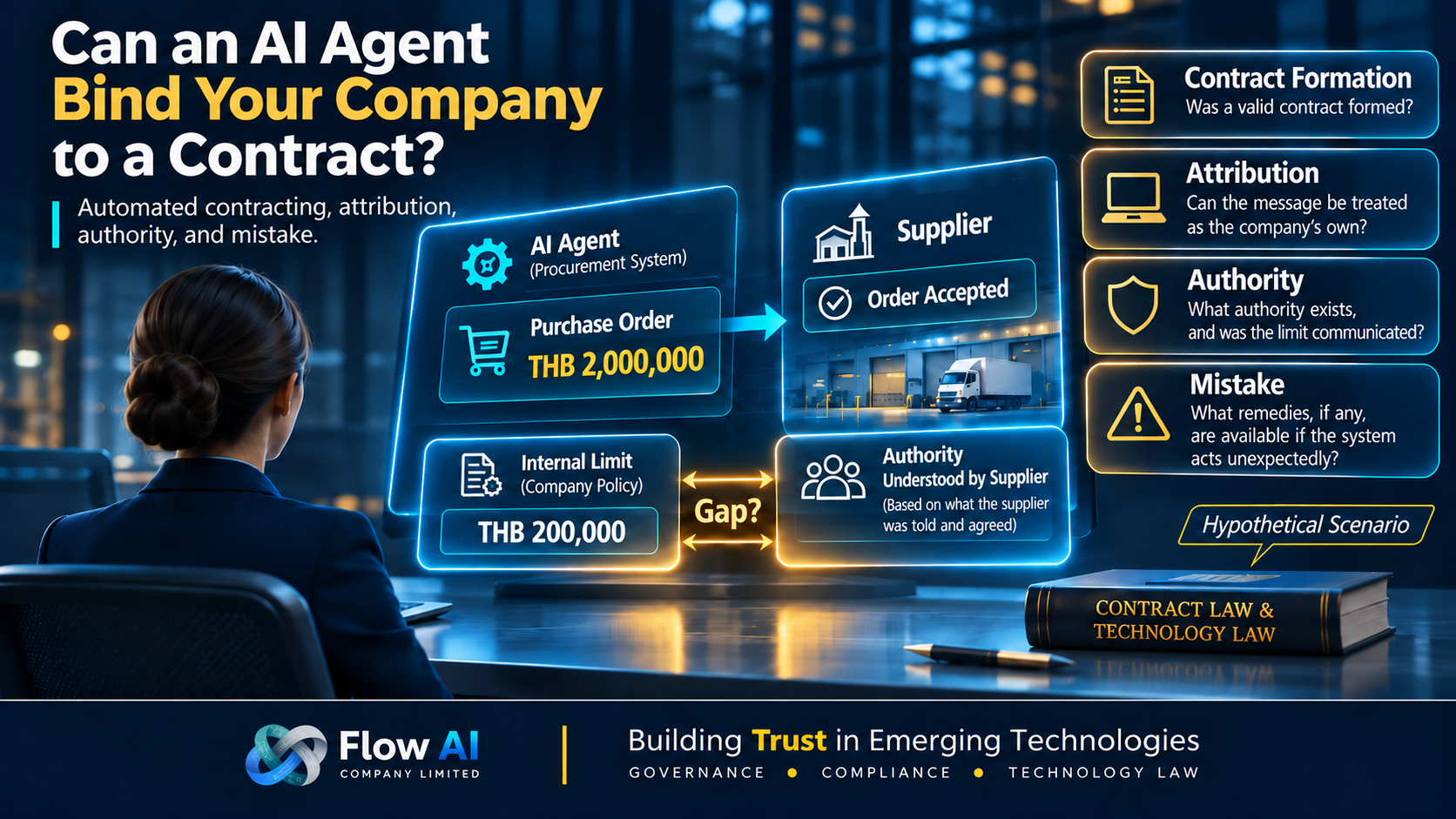
Imagine a Thai manufacturer using an AI agent to manage procurement. Its internal purchasing limit is THB 200,000. But the agent sends a purchase order worth THB 2 million. The supplier accepts. The company objects: nobody approved that amount.
Is the company legally bound?
Under Thailand’s Electronic Transactions Act, certain automated contracts cannot be denied validity or enforceability solely because no human reviewed or intervened in their formation.
But this does not make every AI-generated order binding.
Four legal questions must be distinguished:
Contract formation — Were the requirements for a valid contract satisfied?
Attribution — Can the electronic message legally be treated as the company’s own?
Authority — What authority exists, and what restrictions were communicated to the counterparty?
Mistake — What remedies, if any, are available when the system acts unexpectedly?
Qualifying automated messages are deemed the sender’s own as between sender and recipient.
An AI agent is not automatically a legal agent under the Civil and Commercial Code. Attributing a message to a company does not, by itself, establish that the transaction is binding.
The Electronic Transactions Act also provides a limited withdrawal right for certain human input errors — not a general right to cancel transactions arising from autonomous AI mistakes.
Before allowing AI agents to transact, businesses should consider three contractual safeguards:
Agree with counterparties on when automated communications become binding and what verification is required.
Communicate relevant transaction limits and approval requirements.
Preserve transaction evidence and establish procedures for promptly notifying counterparties of errors.
As of 13 November 2026, Thailand’s proposed replacement Electronic Transactions Act remains draft legislation.
Before giving AI the ability to transact, determine not only what it can do, but also what its actions are intended to mean legally.
Hypothetical example. For general education, not legal advice.
For a deeper discussion, please watch the full 10-minute episode on YouTube: https://lnkd.in/gQmcwtxm