Shadow AI Is Not Just an Employee Compliance Problem
What if an employee uses an unapproved AI tool because the approved way of doing the work simply does not meet the business need?
The employee may still have violated policy. But that may not be the whole compliance diagnosis.
AI compliance requires clear ownership at the point of use. Employees have a responsibility to follow AI policies, use approved systems, protect confidential or personal information, and escalate uncertainty rather than bypass controls.
But accountability should not stop with the individual.
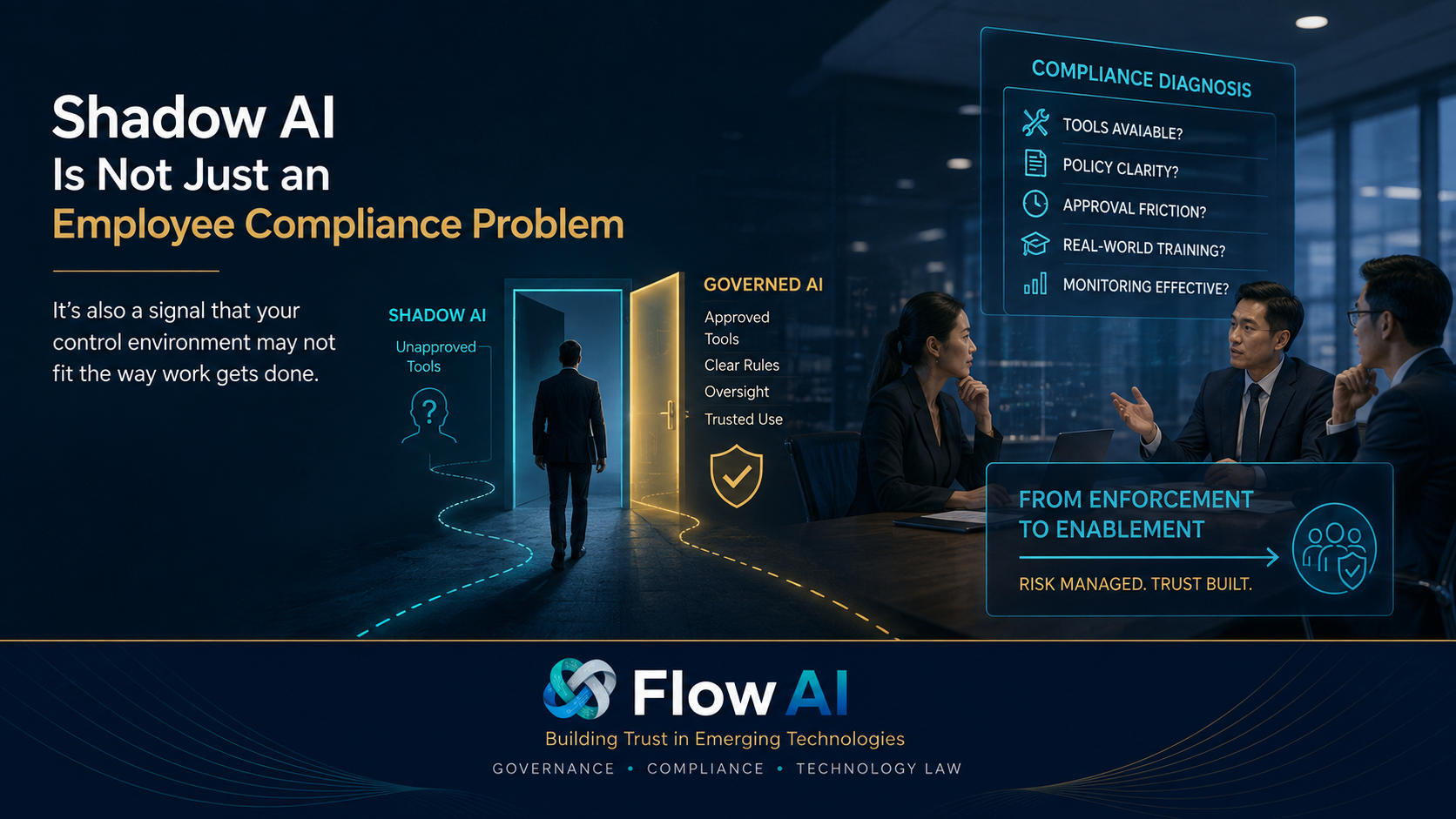
When Shadow AI appears, organizations should also ask why it happened.
→ Were appropriate AI tools actually available?
→ Were employees clear about what was permitted and prohibited?
→ Was the approval process practical for the speed at which the business operates?
→ Did training address real working situations rather than only high-level principles?
→ Could existing controls detect unauthorized AI use before it created greater risk?
Repeated workarounds may reveal something important about the control environment.
If employees consistently turn to unapproved tools because approved alternatives do not meet legitimate business needs, enforcement alone may address the behavior without addressing its cause.
Shadow AI can therefore be more than a risk signal. It can also be a demand signal. It may indicate that employees have identified a genuine use case for AI that the organization has not yet brought into its governed environment.
This does not excuse non-compliance. Some cases will still involve deliberate misconduct.
But mature AI compliance should examine both sides of the event:
What did the employee do?
and
What made unauthorized AI use possible, attractive, or necessary?
For boards and executives, this means treating Shadow AI not only as a disciplinary issue, but also as an opportunity to test whether approved tools, policies, training, approval processes, and monitoring still reflect operational reality.
The objective should not be to prevent every attempt to use AI. It should be to bring legitimate AI use into an environment where the organization can see it, govern it, and manage its risks.
So when Shadow AI appears, ask whether employees followed the rules.
But ask one more question:
Did we build rules, tools, and processes that employees can realistically follow?
And if not, is the real compliance problem larger than the individual incident?