From Compliance Claims to Verifiable Evidence
Organizations often say that they comply with policies, contractual obligations, regulatory requirements, or internal controls.
But increasingly, another question matters:
Can they demonstrate it?
This was another reflection from the “Certification as a Trusted Mechanism for Cross-border Data Transfers” session at IAPP Asia Forum 2026 in Singapore.
The session discussed certification as one mechanism for demonstrating compliance, including the role of independent assessment.
What stood out to me was a broader governance principle that extends well beyond certification itself:
Compliance becomes more credible when it can be supported by evidence.
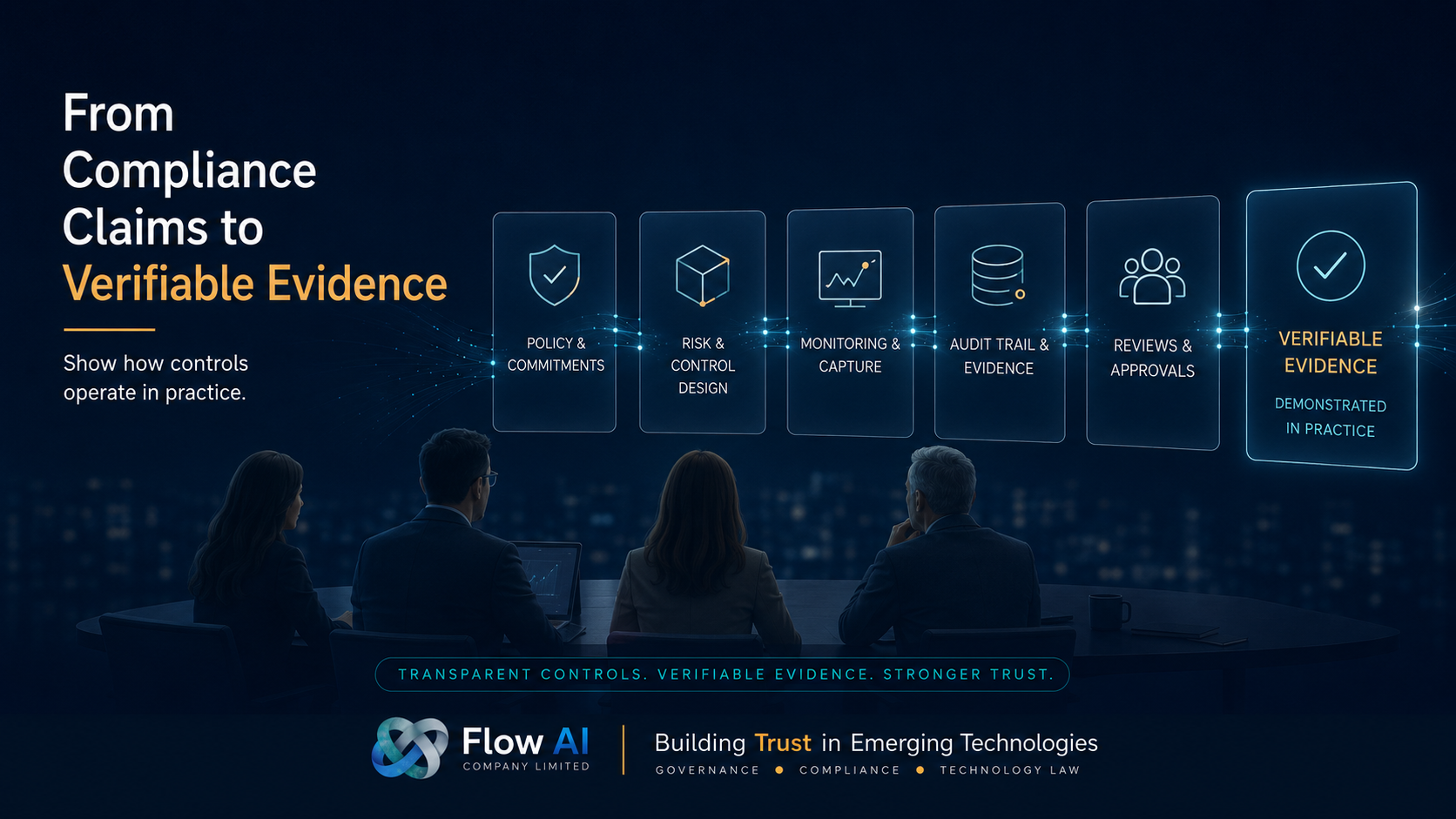
For organizations using AI, cloud services and external technology providers, written policies and contractual commitments are important. But effective governance also depends on whether organizations can show that expected controls are actually operating.
That evidence might include monitoring records, approval logs, audit trails, risk assessments and vendor reviews showing how controls work in practice.
Independent certification can provide one form of external assurance. Under the GDPR, certification is a voluntary accountability mechanism, and the EDPB has approved Europrivacy certification criteria as a European Data Protection Seal that can be used as a transfer tool under Articles 42 and 46 GDPR.
But certification is not the larger point.
The larger point is the shift from:
“We have a policy.”
to
“We can show how the policy is implemented, monitored and evidenced.”
For AI governance and compliance, this distinction will increasingly matter.
Because trust is difficult to build from commitments alone.
It becomes stronger when organizations can demonstrate how those commitments operate in practice.