Human Review Is Not an Effective AI Control by Default
“There is a human in the loop.”
That statement may sound reassuring. But from a compliance perspective, it tells us very little about whether the control is actually effective.
Consider a simple example.
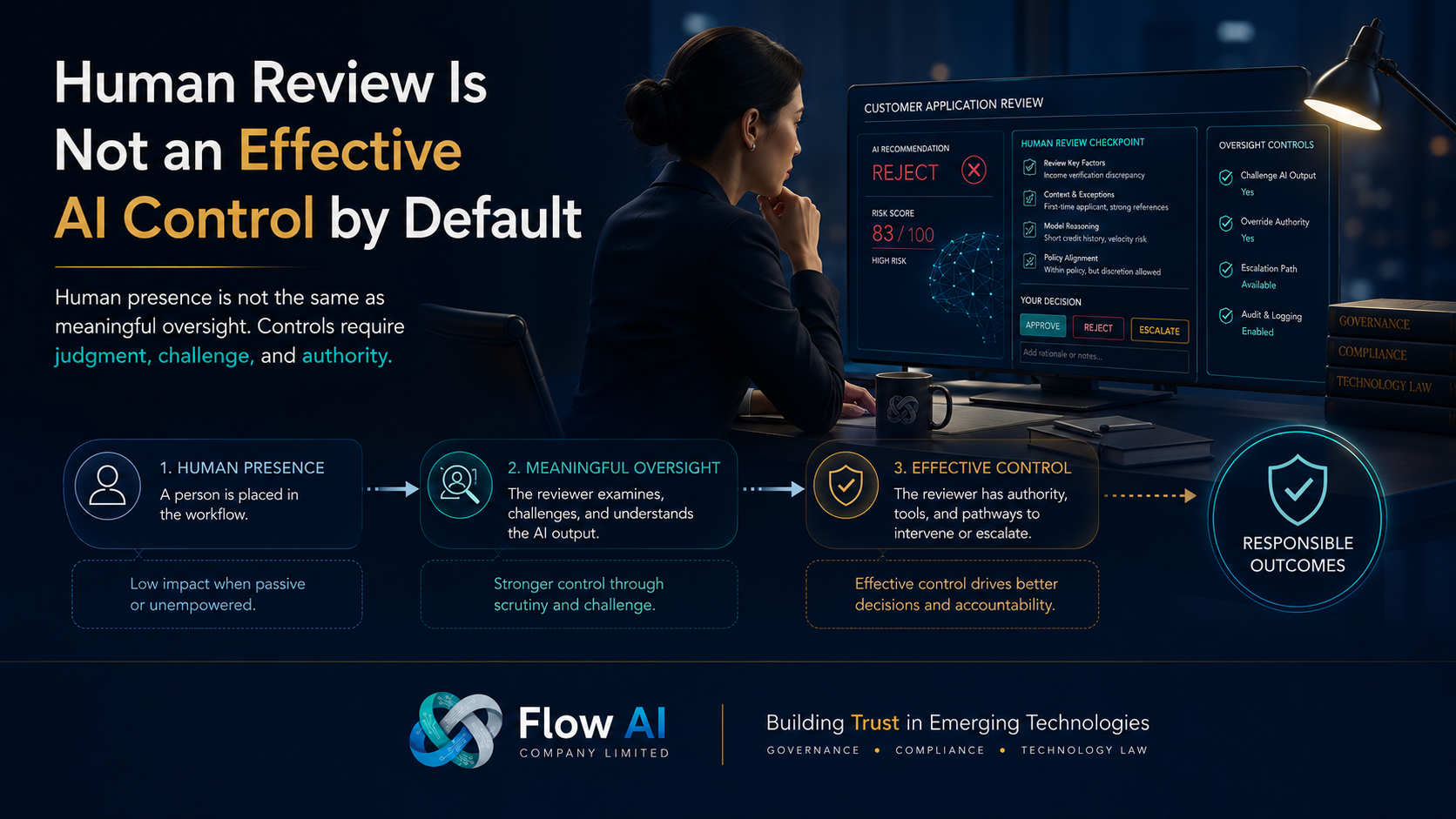
An AI system recommends rejecting a customer’s credit application. A staff member is required to review the recommendation before the decision becomes final.
The reviewer is technically involved. But what if they have only a short time to assess each case, see only a risk score rather than enough information to evaluate the recommendation, and need managerial approval to override the outcome?
The process includes human review. But does it provide meaningful human oversight?
That distinction matters.
A person appearing somewhere in the workflow is not enough. Meaningful oversight requires the reviewer to have sufficient information, competence, time, authority, and clear escalation pathways to exercise independent judgment.
The reviewer must be able to challenge the AI output rather than simply confirm it.
Organizations should also consider automation bias. If employees routinely defer to AI recommendations because the system is perceived as more accurate, objective, or authoritative, the formal ability to override may have little practical value.
But there is another layer.
Even meaningful human oversight should not automatically be treated as an effective operational control. Organizations still need evidence that the control works in practice.
→ Do reviewers actually challenge questionable outputs?
→ Are overrides and escalations documented?
→ Are recurring issues identified and addressed?
→ Are reviewers trained and periodically assessed?
→ Does monitoring show that the control is working as intended?
This leads to an important distinction:
Human review asks: Is a person involved?
Meaningful human oversight asks:
Can that person exercise real judgment and intervene?
Control effectiveness asks: Does that intervention actually manage the intended risk?
For boards, executives, Compliance, Risk, Internal Audit, and AI leaders, the question should therefore go beyond whether a “human in the loop” exists.
The more important question is whether human oversight is properly designed, adequately resourced, consistently performed, documented, monitored, and tested.
Because “human in the loop” describes a workflow.
It does not, by itself, prove that an effective AI control exists.