An AI Policy Is Not an AI Compliance Program
Publishing an AI policy does not mean your organization has an AI compliance program.
Yet many organizations unintentionally treat the two as if they were the same.
A well-written AI policy is an important foundation. It communicates expectations for the responsible use of AI. But by itself, it does not ensure those expectations are consistently translated into day-to-day operations.
In 2023, Samsung reportedly restricted the use of generative AI tools after employees uploaded confidential internal information into ChatGPT. For many organizations, the incident highlighted that AI adoption introduces operational risks—not just technology risks.
The important questions are no longer whether an AI policy exists.
They are whether the organization was prepared.
Who approved the use of the AI tool?
Had employees received appropriate guidance and training?
Were proportionate controls in place to protect sensitive information?
How would an incident be identified, escalated, investigated, and documented?
These questions distinguish an AI policy from an AI compliance program.
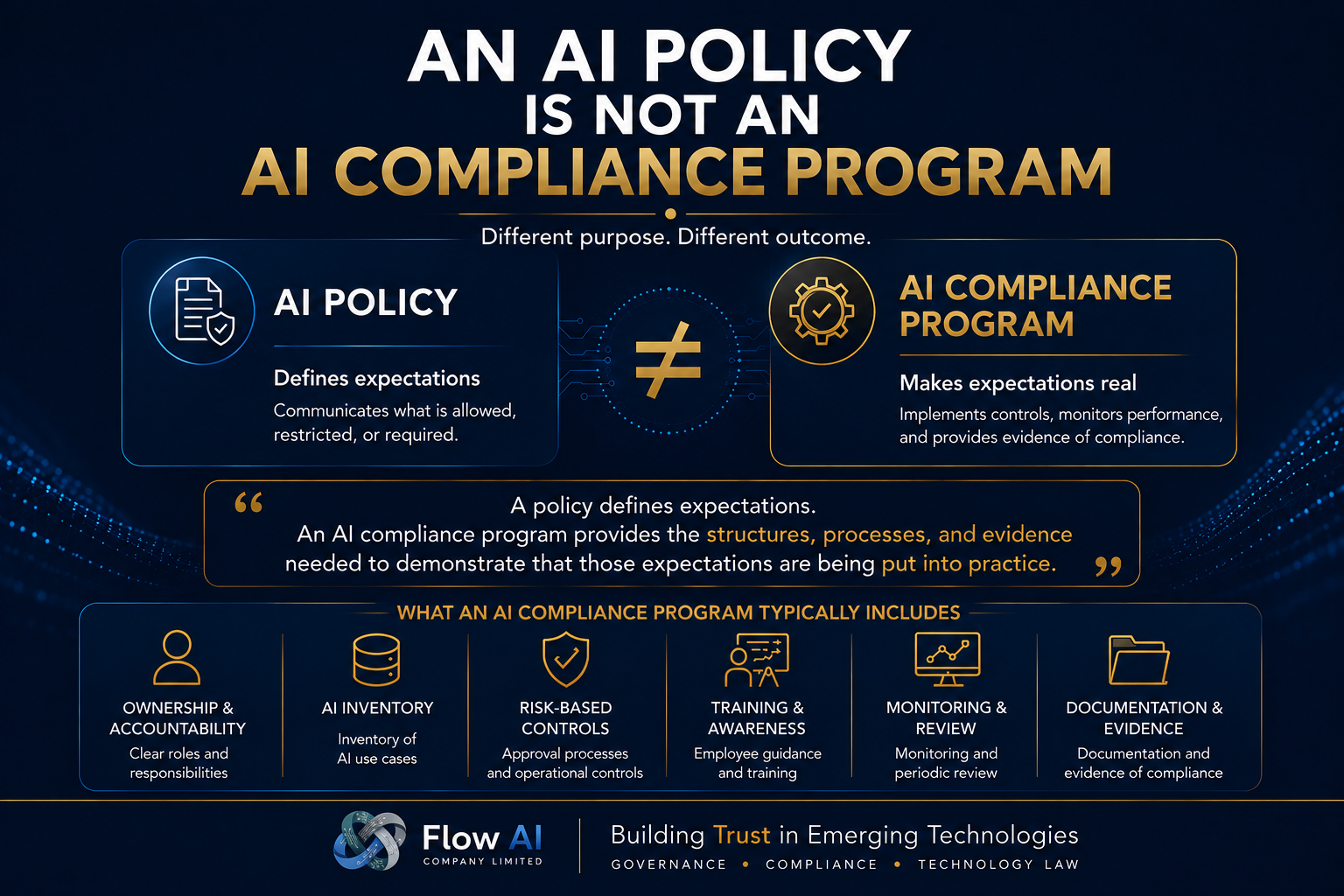
A policy defines expectations.
An AI compliance program provides the structures, processes, and evidence needed to demonstrate that those expectations are being put into practice.
Depending on an organization's size, industry, and AI risk profile, a practical program may include:
• Clear ownership and accountability
• An inventory of AI use cases
• Risk-based approval processes and operational controls
• Employee awareness and training
• Monitoring and periodic review
• Documentation and evidence
There is no universal blueprint. Organizations should build compliance programs that are proportionate to their business, their AI use, and the risks they face.
The objective is not to create more documentation. It is to provide leadership with confidence that AI is being used responsibly, consistently, and in line with the organization's own commitments.
From my perspective as a lawyer and former operations executive, organizations create far more value by embedding policies into everyday operations than by simply publishing them.
As AI adoption continues to grow, leaders should ask one simple question:
Do we have an AI policy or have we built an AI compliance program that actually works?