AI Governance and AI Compliance Are Not the Same
An organization may have an AI policy, an AI committee, and an approval process—and still lack an effective AI compliance program.
The reason is simple: AI governance and AI compliance are closely connected, but they perform different organizational functions.
This distinction becomes more important with AI.
AI systems can be deployed quickly across business functions, produce variable outputs, rely on external providers, and increasingly influence—or execute—decisions at speed.
As a result, the distance between an approved governance principle and what actually happens in daily operations can widen rapidly.
Consider a customer-service team that receives approval to use an AI chatbot. The governance framework requires certain queries to be escalated for human review.
But no one is assigned to monitor whether the escalation rule is followed, document exceptions, or report recurring failures.
The governance decision exists. The compliance mechanism does not.
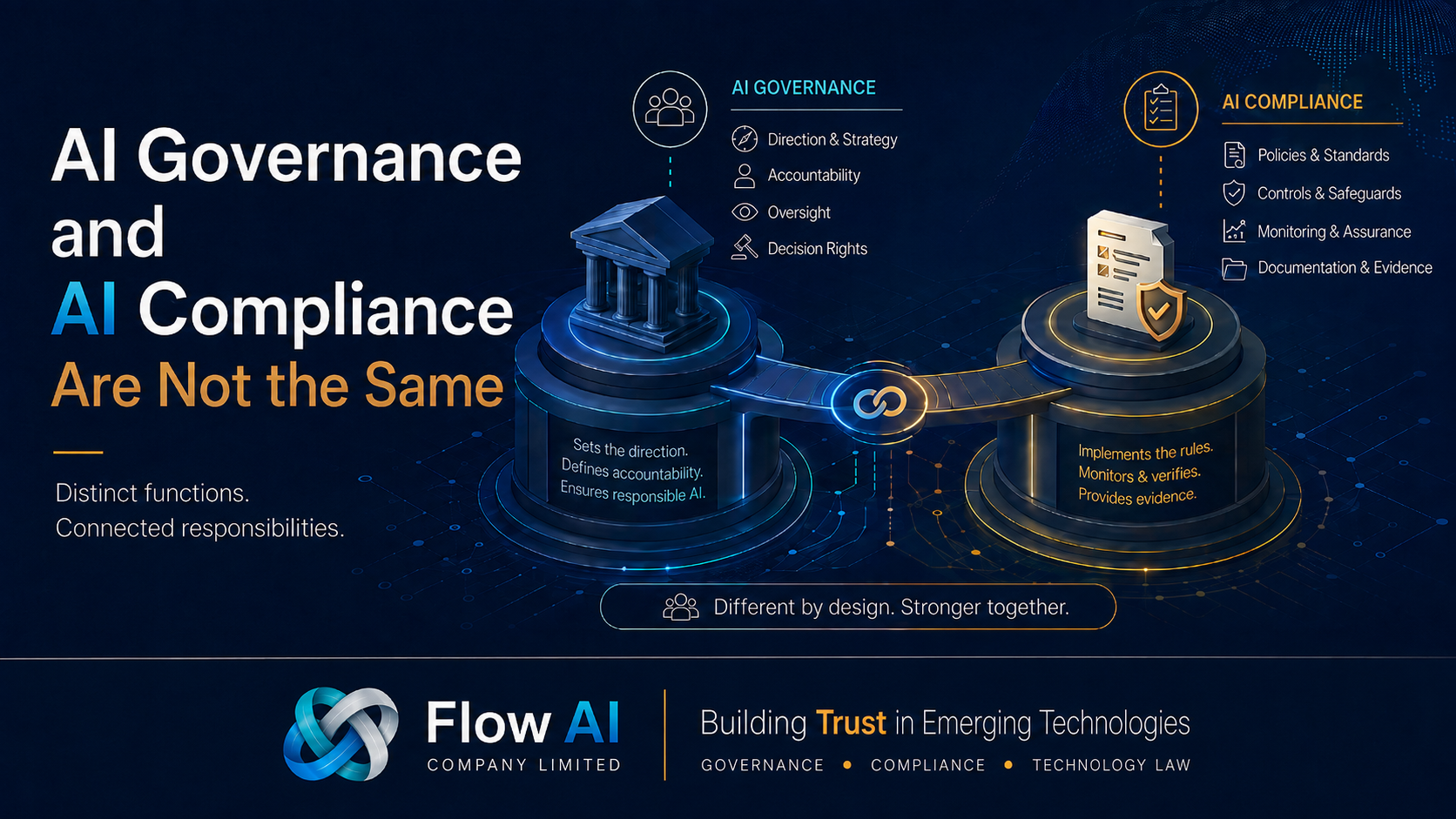
AI governance establishes direction, accountability, decision rights, risk ownership, and oversight. It determines who may approve AI use, what level of risk is acceptable, which issues require escalation, and what information should reach senior management or the board.
AI compliance translates those expectations, together with applicable obligations and internal commitments, into operational practices: policies, controls, procedures, training, monitoring, documentation, escalation, and evidence.
When governance decisions are not translated into responsibilities and controls, they may remain statements of intent. At the same time, compliance activity without clear direction and risk ownership can become fragmented, reactive, and disconnected from business decisions.
The relationship is therefore not a simple handoff.
From my operational leadership experience, compliance monitoring can expose control weaknesses, recurring incidents, and unclear responsibilities that require governance decisions.
Legal, Compliance, Risk, Privacy, Cybersecurity, and Internal Audit may advise, challenge, monitor, or provide assurance. But they should not automatically become the owners of every risk created by the business use of AI.
The business function selecting, deploying, or relying on an AI system should remain appropriately accountable for its purpose, use, outcomes, and operational risks.
For boards and executives, the practical test is straightforward:
Can the organization show who made the AI decision, who owns the resulting risk, what controls apply, how those controls are monitored, and what happens when they fail?
AI governance sets direction and accountability.
AI compliance makes those expectations operational, demonstrable, and reviewable.
Organizations need both—and they need clear business ownership to connect them.